Back
23.25° N  ·  69.66° E  ·  Kutch

Gujarat · Kutch · Chapter One

Bhuj

भुजः · कच्छस्य हृदयम्

Bhuj is the cultural gateway. Kutch is the living landscape of art.

23.25° N  ·  69.66° E  ·  in the lap of the Rann

“Bhuj tribal art” is not one single art form. Bhuj is the cultural gateway; Kutch is the living landscape of art. What we call Bhuj art is really the larger art, craft, and visual culture of Kutch district and its surrounding villages — Bhujodi, Ajrakhpur, Nirona, Hodka, Banni, Sumrasar — where traditions are preserved, revived, and seen by the outside world. Its artistic traditions come from communities such as the Rabari, Ahir, Jat, Mutwa, Meghwal, Khatri, Marwada, and Maheshwari — each carrying its own visual language.

I

Chapter One

The Art in the Land

भूमिः · where light, salt, and silence become form

Kutch is a region in western Gujarat shaped by arid land, seasonal marshes, grasslands, coastline, migration routes, and desert ecology. Its most iconic landscape is the Rann of Kutch — a vast salt marsh that includes the Great Rann, the Little Rann, and nearby ecological zones such as the Banni grasslands.

The land is not just scenery. In Kutch, the land itself shapes the art — the dryness, brightness, emptiness, and texture of the region decide the colors people use, the materials they choose, the patterns that stand out, and the need for portable and durable art forms.

The desert does not erase beauty here. It sharpens it. The art in the land is visible in the way Kutch turns environmental harshness into visual richness — a relationship between light, cloth, and surface that is almost impossible to explain without standing inside it.

The White Rann can be read as a natural artwork — emptiness, reflection, brightness, silence, illusion.

In the dry season, the White Rann becomes an endless reflective surface that changes with sunlight, sunset, moonlight, and shadow. It creates mood, scale, and visual drama before a single human object enters the frame. That is why the landscape itself already feels artistic.

Bhuj: the place
Bhuj — the placeWikimedia Commons
II

Chapter Two

The Art in the Craft

शिल्पम् · where process becomes pattern

This is the most direct category, because here art exists through handmade practice. Ajrakh, Rogan, Bandhani, and mirror work are not just crafts in a commercial sense. They are art systems — each carrying memory, material intelligence, identity, and history.

  • Rabari
  • Ahir
  • Jat
  • Mutwa
  • Meghwal
  • Khatri
  • Marwada
  • Maheshwari

I · Block Printing

The art in Ajrakh

Ajrakh is one of Kutch's most complex textile traditions, associated mainly with the Khatri community and especially with places like Ajrakhpur. It is made through a long process of block printing, resist work, mordanting, washing, and dyeing — often with colors like indigo, red, black, and white.

The art in Ajrakh is not just in the final pattern. It lies in alignment, repetition, symmetry, mathematical order, natural dye knowledge, and the balance between discipline and beauty.

Ajrakh is art through precision. It turns process into visual rhythm.

II · Painted Cloth

The art in Rogan

Rogan art is one of the rarest artistic traditions of Kutch, practiced especially in Nirona. It uses a thick paint-like paste made from castor oil and pigment, applied to cloth using a metal tool — thick, glossy lines pulled out of air.

The art in Rogan lies in hand control, fluid symmetry, delicate movement, paint behavior, pattern memory, and the survival of a rare visual language. Rogan is art through gesture — drawing, painting, and ornament all fused into one.

III · Tie & Dye

The art in Bandhani

Bandhani is Kutch's tie-and-dye tradition, historically associated with the Khatri community. It is created by tying hundreds or thousands of tiny knots in cloth before dyeing it.

The art in Bandhani lies in tiny repeated labor, transformation through dye, the building of large patterns from small tied points, and the control of density and spacing. Bandhani is art through patience — microscopic acts becoming a large visual field.

IV · Abhla Bharat

The art in Mirror Work

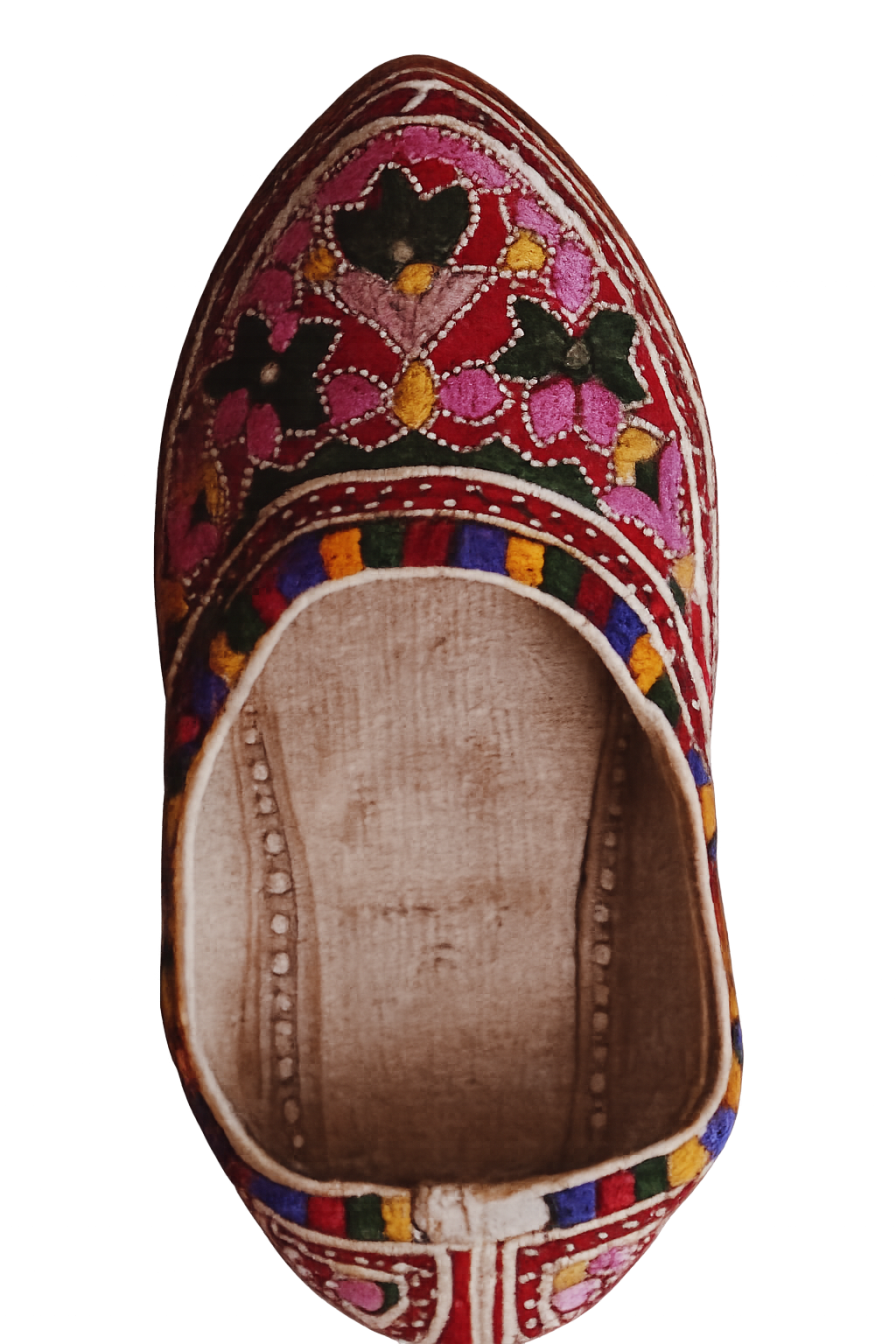
Mirror work — abhla bharat — is an important part of Kutch embroidery, appearing in the work of communities such as the Rabari, Ahir, and Jat. Small mirrors are stitched into textiles with embroidery, creating sparkling, reflective surfaces.

The art in mirror work lies in interaction with light, movement across fabric, and ornament becoming reflection. Mirror work is art through light — it makes surface behave like a living thing.

Bhuj: landscape
Bhuj — landscapeWikimedia Commons
III

Chapter Three

The Art in Community and Identity

समुदायः · belonging stitched into being

Bhuj and Kutch art is deeply tied to specific communities — the Rabari, Ahir, Jat, Mutwa, Meghwal, Khatri, Marwada, and Maheshwari. Each community carries its own artistic language, visible in embroidery, textiles, patterns, ornament, and material choice.

  • Rabari
  • Ahir
  • Jat
  • Mutwa
  • Meghwal
  • Khatri
  • Marwada
  • Maheshwari

The art in identity lies in how people make belonging visible. In Kutch, art expresses who made the object, who wears it, which community it belongs to, what traditions it continues, and how memory passes across generations.

Here, art is not separate from life. It is stitched into social existence.

A Rabari veil reads differently from an Ahir blouse. A Jat dowry cloth says something no Meghwal border ever would. These are not decorative choices; they are signatures. The art is how a community introduces itself without speaking.

Bhuj: the craft
Bhuj — the craftWikimedia Commons
IV

Chapter Four

The Art in the Living Earthquake

स्मृतिः · rebuilding as a cultural act

The 2001 Gujarat earthquake devastated Kutch, especially Bhuj and its surrounding regions. It caused enormous destruction to homes, settlements, and infrastructure — and changed the cultural and physical landscape of the district.

26 Jan
2001 · Republic Day morning
~20,000
Lives lost
~166,000
Injuries recorded
Mw 7.7
Magnitude

It may sound unusual, but the art in this chapter lies in rebuilding as a cultural act. After the earthquake, the challenge was not only to reconstruct buildings, but to rebuild social memory, village form, traditional ways of living, and visual and architectural identity.

So the art here is the art of survival, adaptation, and rebuilding with dignity.

Gandhi-nu-Gam is an important example of post-earthquake recovery in Kutch — a participatory and culturally sensitive redevelopment that preserved local settlement patterns while improving safety and living conditions.

The art in Gandhi-nu-Gam lies in rebuilding without erasing identity. Architecture and planning can be cultural art forms too — when they respect memory, community, and place.
Bhuj: material
Bhuj — materialWikimedia Commons
V

Chapter Five

The Art in the Sky That Remembers

आकाशः · the desert performs

The White Rann is one of Kutch's most iconic natural features. During the dry season, the salt-marsh surface becomes a glowing white plain that shifts dramatically with light and time of day.

The art in the sky lies in the changing atmosphere of Kutch — sunrise, afternoon glare, sunset, dusk, full moon. The sky and salt plain together form a natural visual composition. This is environmental art, where the region itself performs visually.

The landscape becomes event. The event becomes memory.

Rann Utsav is the cultural festival that ties this landscape to celebration — music, dress, craft, the architecture of temporary spaces, light, desert atmosphere, and performance. The art in Rann Utsav is the art of landscape becoming event and memory; of a region presenting itself, at scale, to anyone willing to listen.

VI

Chapter Six

The Art in the Kitchen

रसोई · richness from limitation

Kutchi food reflects the climate, material conditions, and way of life of the region. Bajre ja rotla, odho, kadhi, garlic chutney, jaggery, pakwan, and chhaas are the important parts of local cuisine — a kitchen built entirely out of what the land makes possible.

  • Bajre ja rotla
  • Odho
  • Kadhi
  • Garlic chutney
  • Chhaas
  • Pakwan

The art in the kitchen lies in transforming limited regional resources into meals with strong identity. Kutchi food is art through balance, adaptation, regional taste memory, texture, and climate-sensitive cooking. It shows how everyday life can also be artistic.

The art in bajre ja rotla is in how a simple millet flatbread reflects local grain, climate, nourishment, and tradition. The art in odho is in how a roasted, mashed preparation turns a humble ingredient into something memorable and smoky.

Kadhi represents the quiet side — soft, cooling, and balancing. Garlic chutney is strong, sharp, and intense — flavor without apology. Honestly, respect. Chhaas reflects climate intelligence: simple, cooling, and necessary in a hot dry region.

Use what the land gives. Adapt to difficulty. Create richness from limitation. Keep memory inside everyday things.
Bhuj: colour
Bhuj — colourWikimedia Commons
VII

Chapter Seven

The Art in Everyday Life

जीवनम् · art as the water around the fish

One of the most important things about Bhuj and Kutch is that art is not locked inside a museum. It appears in textiles, clothing, cooking, villages, rebuilding, festivals, landscape, and domestic objects — all at once, without asking for attention.

That means art in Kutch is not just something people make. It is something people live inside. Cloth becomes ornament. Ornament becomes belonging. Belonging becomes memory. Memory becomes the next pattern.

In Kutch, art exists in land, craft, survival, celebration, and everyday living — all at once.

Bhuj tribal art, understood properly, is the wider art and cultural ecosystem of Kutch, with Bhuj as its urban and cultural center. Here, art emerges through environment, memory, labor, and daily practice. A region where a salt desert, a block-printed cloth, a kitchen fire, and a rebuilt village all share the same grammar.

Bhuj: surface
Bhuj — surfaceWikimedia Commons

यत्र भूमिः स्मरति, तत्र शिल्पं जीवति

where the land remembers, the craft lives.