Back
32.56° N  ·  76.13° E  ·  Ravi Valley · The Story Cloth

Himachal Pradesh · Chapter Eight

Chamba

The Embroidered Story Cloth

चंबा

A town of narrative embroidery, where the Chamba Rumal stitches courtly and mythic scenes into a double-sided story cloth.

32.56° N  ·  76.13° E  ·  Ravi Valley · The Story Cloth

Chamba is a town of narrative embroidery, where the Chamba Rumal stitches courtly and mythic scenes into a double-sided story cloth. Within the craft archive of Himachal Pradesh, it is read here through eight chapters — identity, landscape, craft, materials, motifs, colour, surface, and story — each a slow look at how this place makes and remembers.

I

Chapter One

City Identity

चंबा

Chamba is a town of narrative embroidery, where the Chamba Rumal stitches courtly and mythic scenes into a double-sided story cloth. That is the first thing to hold before any single craft is named — a city is a temperament before it is a technique, and Chamba has a temperament you can feel in its streets before you ever see an object made.

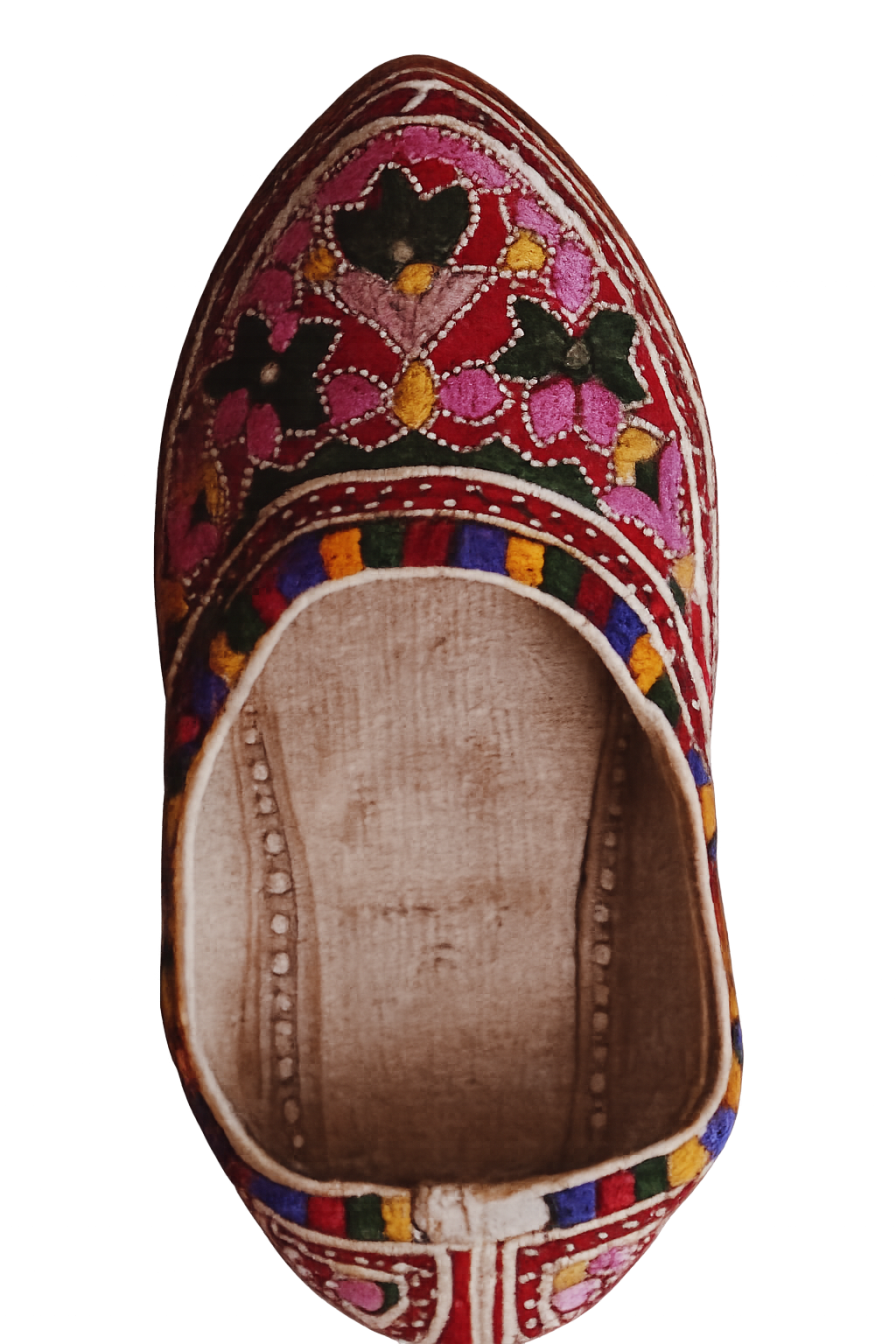
In the larger archive of Himachal Pradesh, Chamba is not interchangeable with its neighbours. Where other places lean one way, Chamba leans toward Chamba Rumal — fine double-satin-stitch embroidery that reads identically on both faces — with Chamba chappal and metal craft, and that leaning organises everything else: the markets, the working hours, the materials that arrive at the door, and the things people are proud to show a visitor.

Its anchor crafts — Chamba Rumal, Chamba chappal, Miniature influence, and Metal craft — are not a list of products so much as a description of how the city thinks with its hands. Each one carries a discipline that has been refined across generations, defended quietly against the speed of everything around it.

To read Chamba closely, then, is to read Himachal Pradesh at close range. The chapters that follow move from the land outward to the thread, the mark, the colour, and finally the living people who still carry the work — because identity here is not a label but a practice that is still going on.

Chamba stitches story into double-sided cloth.
II

Chapter Two

Landscape & Setting

चंबा

The setting of Chamba is the Ravi valley town, the old temples, the stone-paved chowgan, and the steep wooded slopes around. Geography is never neutral in a craft city; it decides what can be made before anyone decides to make it.

The land here sets the supply. It determines which materials are near and which must be carried in, what the seasons allow, and what light falls across the worktable when the day’s work begins. A craft is, in part, an argument with its own geography.

There is a sensory weather to this place as much as a physical one — the particular quality of its water, its dust, its heat or cold, the sounds that fill its lanes. Makers absorb all of it, and it surfaces later in the patience or the boldness of the finished object.

So before the craft, the country. The Ravi valley town, the old temples, the stone-paved chowgan, and the steep wooded slopes around is not a backdrop to the work of Chamba; it is the first cause of it, the reason the city reaches for one material and one rhythm rather than another.

Chamba: Landscape
Chamba — landscapeWikimedia Commons
III

Chapter Three

Main Craft / Cultural Anchor

चंबा

The cultural anchor of Chamba is Chamba Rumal — fine double-satin-stitch embroidery that reads identically on both faces — with Chamba chappal and metal craft. This is the thread the rest of the city hangs from.

The work is exacting in ways that are easy to miss from the outside. Chamba Rumal — fine double-satin-stitch embroidery that reads identically on both faces — with Chamba chappal and metal craft is built from small, repeated decisions — each one minor on its own, but together they separate a practised hand from an unpractised one. The skill lives in those decisions, not in any single dramatic gesture.

It is also a lineage. The craft is taught the slow way, by sitting beside someone who already knows, and it carries the corrections of many earlier hands inside it. What looks like tradition is really accumulated problem-solving, passed down because it works.

That is why this craft matters beyond its objects. It holds a form of knowledge that no manual fully captures, and as long as Chamba keeps practising Chamba Rumal — fine double-satin-stitch embroidery that reads identically on both faces — with Chamba chappal and metal craft, that knowledge stays alive in the only place it can — in the hands that do it.

Chamba stitches story into double-sided cloth.
Chamba: The craft
Chamba — the craftWikimedia Commons
IV

Chapter Four

Materials

चंबा

Every craft begins as raw material, and in Chamba the work starts with Fine cloth above all. The material is the first collaborator, with its own grain, weight, and will.

The working vocabulary here runs through Fine cloth, Silk thread, Leather, Pigment, and Metal. None of these is chosen at random; each is selected for how it holds an edge, a colour, a knot, or a line, and for how it behaves under the particular hand that works it.

Material also means preparation. Before anything is made, there is sourcing, sorting, cleaning, soaking, firing, or seasoning — the unglamorous early labour that decides whether the finished piece will last. Half the craft is over before the object visibly begins.

And material sets the limits that give the work its character. Fine cloth can do certain things and refuses others, and the form of the craft in Chamba is, in large part, an honest response to what its materials allow.

  • Fine cloth
  • Silk thread
  • Leather
  • Pigment
  • Metal
Chamba: Material
Chamba — materialWikimedia Commons
V

Chapter Five

Motifs

चंबा

A motif is memory made repeatable. In Chamba, the visual language returns again and again to a small family of forms — beginning with the embroidered figures — that carry the meaning of the place.

That family includes Embroidered figures, Floral borders, Temple line, and Leather stitch. Each is a shorthand, a shape compact enough for a hand to repeat and rich enough to hold a story, a season, or a belief.

The motifs come from somewhere real. They are drawn from the landscape, from faith, from daily habit and the things people see most — which is why they feel inevitable here and would feel borrowed anywhere else.

Repetition is the point, not a weakness. Each time a maker in Chamba lays down a familiar motif, it is both the same and slightly new, and the pattern becomes a way of remembering that survives precisely because it is made again and again.

  • Embroidered figures
  • Floral borders
  • Temple line
  • Leather stitch
Chamba: Detail
Chamba — detailWikimedia Commons
VI

Chapter Six

Colour Palette

चंबा

Colour in Chamba is cream, pink, red, green, gold, and leather brown — the narrative palette of the story cloth. A palette is a place’s emotional signature long before it is a set of pigments.

These tones are not arbitrary. They are drawn from the city’s own earth, water, metal, and cloth — the colours that were always at hand, so that even the brightest of them feels rooted rather than imported.

There is craft in the colour itself. Whether it comes from natural dye, mineral pigment, the heat of a kiln, or the patina of worked metal, each tone is the result of a process, and an experienced maker reads colour as a record of how something was made.

Held together, the palette becomes a mood you can recognise across objects. It is how Chamba feels before you can say why — the quiet agreement of colours that all came from the same ground.

VII

Chapter Seven

The Surface

चंबा

If Chamba were a moving surface, it would behave like this: embroidery stitches slowly draw story-like figures and borders, the detail panel opening like a cloth.

The gesture is deliberately quiet. In an archive like this, the interaction should echo the craft rather than compete with it — a small, premium motion that rewards attention instead of demanding it.

Mechanically it stays light and slow: a soft draw, a gentle fade, a single sweep of light, nothing loud, nothing that would tire the eye or the device. The animation is a whisper of the material, not a performance.

That is the principle for Chamba on screen — atmosphere over announcement. The surface should feel handmade and unhurried, the way the craft itself does, so that moving through the page feels like turning an object slowly in the light.

VIII

Chapter Eight

Cultural Storytelling

चंबा

Chamba is not a museum case. The craft here is still worked, still sold, still arriving in new hands and changing slightly with each of them.

It is carried by real people — the makers, the families, the small workshops who keep Chamba Rumal — fine double-satin-stitch embroidery that reads identically on both faces — with Chamba chappal and metal craft going not as heritage performance but as a living trade with its own pressures and pride.

And it keeps changing. New materials, new buyers, and new tools press on the old practice, and the craft answers by adapting without dissolving — which is exactly how a living tradition stays alive rather than becoming a relic.

That is the whole intent of this archive: to hold the living thread of Chamba without pinning it down, and to let it remain what it has always been — a place that makes, and not only a place that is remembered.

Chamba stitches story into double-sided cloth.

चंबा

Chamba stitches story into double-sided cloth.