Back
21.52° N  ·  70.46° E  ·  Saurashtra · Girnar Foot

Gujarat · Saurashtra · Girnar Foot

Junagadh

Fort, Faith, and Forest

જૂનાગઢ

An ancient city at the foot of Mount Girnar — a layered geography of sacred peaks, fort and tomb architecture, and Saurashtra craft.

21.52° N  ·  70.46° E  ·  Saurashtra · Girnar Foot

Junagadh is an ancient city at the foot of Mount Girnar — a layered geography of sacred peaks, fort and tomb architecture, and Saurashtra craft. Within the craft archive of Gujarat, it is read here through eight chapters — identity, landscape, craft, materials, motifs, colour, surface, and story — each a slow look at how this place makes and remembers.

I

Chapter One

City Identity

જૂનાગઢ

Junagadh is an ancient city at the foot of Mount Girnar — a layered geography of sacred peaks, fort and tomb architecture, and Saurashtra craft. A city is a temperament before it is a technique, and Junagadh carries one you can feel before you ever watch a single object being made.

In the wider archive of Gujarat, Junagadh is nobody’s copy. Where its neighbours lean one way, Junagadh leans toward architectural and ritual craft — carved stone, the layered Indo-Islamic tomb architecture, pilgrimage objects, and regional bead and mirror embroidery, and that leaning quietly organises its markets, its working hours, and the things its people are proud to set in front of a visitor.

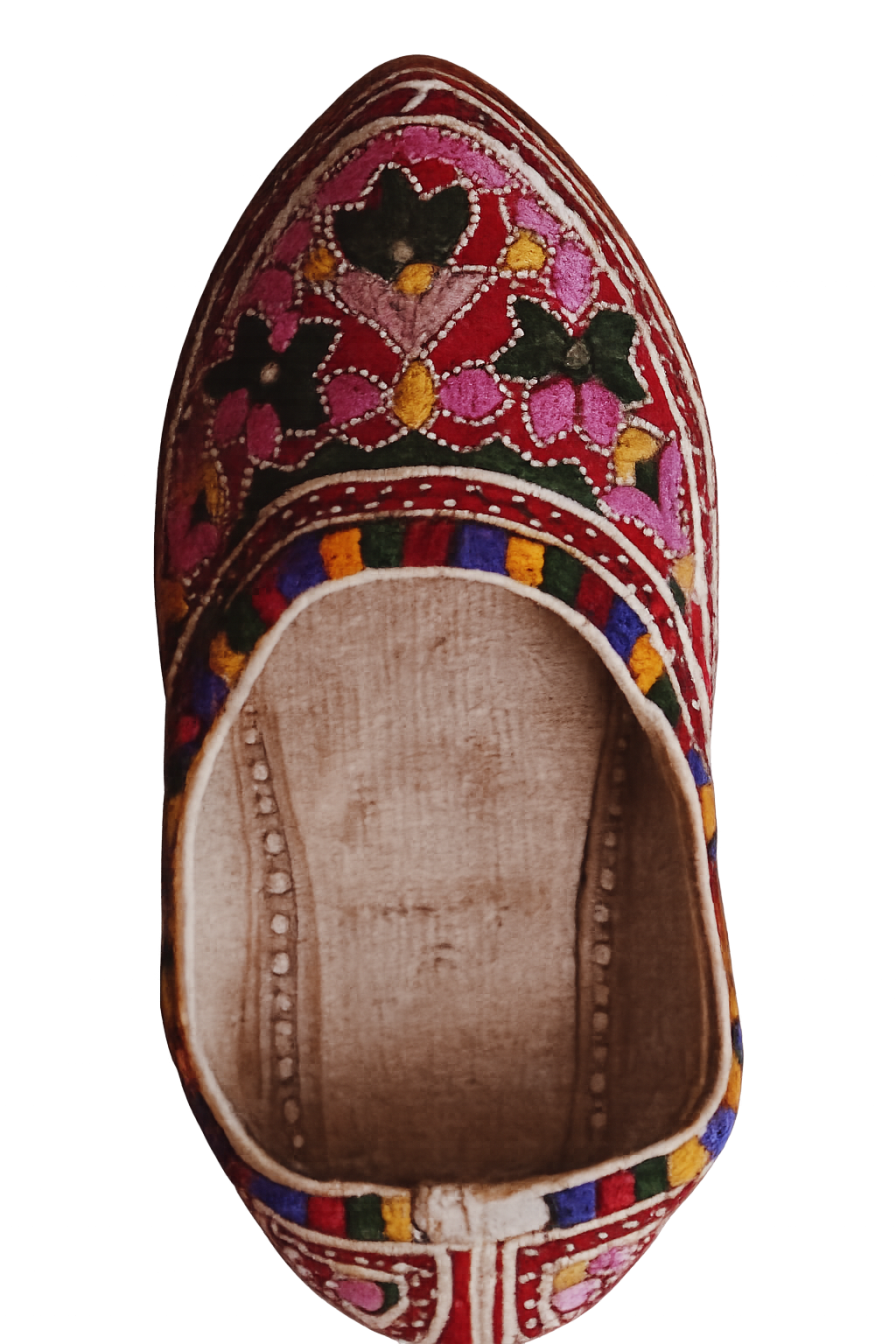
Its anchor crafts — Stone & tomb architecture, Bead work, Saurashtra embroidery, Ritual / pilgrimage craft, and Brass — are less a product list than a description of how the city thinks with its hands, each one a discipline refined across generations.

To read Junagadh closely is to read Gujarat at close range: the same earthy, museum-quiet attention to material, narrowed to one place’s streets and one community’s patience.

Junagadh stacks faith, fort, and forest into one skyline.
Junagadh: the place
Junagadh — the placeWikimedia Commons
II

Chapter Two

Landscape & Setting

જૂનાગઢ

The setting of Junagadh is Girnar's pilgrim peaks, the rock-cut Uparkot fort, the spiralling minarets of the Mahabat Maqbara, and the edge of the Gir lion forest. Geography is never neutral in a craft city; it decides what can be made before anyone decides to make it.

The land here sets the supply — which materials arrive, what the seasons permit, and what light falls across the worktable when the day begins.

There is a sensory weather to the place as much as a physical one: its particular water, dust, heat, and the sounds of its lanes, all of which surface later in the patience or boldness of the finished work.

So before the craft, the country. This landscape is not a backdrop to Junagadh; it is the first cause of it, the reason the city reaches for one material and one rhythm rather than another.

Junagadh: landscape
Junagadh — landscapeWikimedia Commons
III

Chapter Three

Main Craft / Cultural Anchor

જૂનાગઢ

The cultural anchor of Junagadh is architectural and ritual craft — carved stone, the layered Indo-Islamic tomb architecture, pilgrimage objects, and regional bead and mirror embroidery. This is the thread the rest of the city hangs from.

The work is exacting in ways easy to miss from outside — built from small, repeated decisions that together separate a practised hand from an unpractised one. The skill lives in those decisions, not in any single dramatic gesture.

It is also a lineage, taught the slow way by sitting beside someone who already knows, carrying the corrections of many earlier hands. What looks like tradition is really accumulated problem-solving, kept because it works.

That is why this craft matters beyond its objects: it holds knowledge no manual fully captures, alive only in the hands that keep doing it.

Junagadh stacks faith, fort, and forest into one skyline.
Junagadh: the craft
Junagadh — the craftWikimedia Commons
IV

Chapter Four

Materials

જૂનાગઢ

Every craft begins as raw material, and in Junagadh the work starts with Stone above all — the first collaborator, with its own grain, weight, and will.

The working vocabulary runs through Stone, Brass, Beads, Cotton thread, and Mirror. None is chosen at random; each is selected for how it holds an edge, a colour, a knot, or a line under the particular hand that works it.

Material also means preparation — sourcing, sorting, soaking, firing, or seasoning — the unglamorous early labour that decides whether the finished piece will last. Half the craft is over before the object visibly begins.

And material sets the limits that give the work its character: Stone can do certain things and refuses others, and the form of the craft in Junagadh is, in large part, an honest answer to what its materials allow.

  • Stone
  • Brass
  • Beads
  • Cotton thread
  • Mirror
Junagadh: material
Junagadh — materialWikimedia Commons
V

Chapter Five

Motifs

જૂનાગઢ

A motif is memory made repeatable. In Junagadh, the visual language returns again and again to a small family of forms — beginning with the girnar peak line — that carry the meaning of the place.

That family includes Girnar peak line, Spiral minaret, Ashokan rock edict, Beadwork grid, and Stepwell arch. Each is a shorthand, a shape compact enough for a hand to repeat and rich enough to hold a story, a season, or a belief.

The motifs come from somewhere real — drawn from the landscape, from faith, from daily habit and the things people see most — which is why they feel inevitable here and borrowed anywhere else.

Repetition is the point, not a weakness: each time a maker in Junagadh lays down a familiar motif it is both the same and slightly new, and the pattern becomes a way of remembering that survives because it is made again and again.

  • Girnar peak line
  • Spiral minaret
  • Ashokan rock edict
  • Beadwork grid
  • Stepwell arch
VI

Chapter Six

Colour Palette

જૂનાગઢ

Colour in Junagadh is stone grey, ochre, deep forest green, brass, and indigo — the weathered palette of fort and hill. A palette is a place’s emotional signature long before it is a set of pigments.

These tones are not arbitrary — drawn from the city’s own earth, water, metal, and cloth, so that even the brightest of them feels rooted rather than imported.

There is craft in the colour itself: whether from natural dye, mineral pigment, the heat of a kiln, or the patina of worked metal, each tone is the result of a process, and an experienced maker reads colour as a record of how something was made.

Held together, the palette becomes a mood you can recognise across objects — how Junagadh feels before you can say why, the quiet agreement of colours that all came from the same ground.

Junagadh: colour
Junagadh — colourWikimedia Commons
VII

Chapter Seven

The Surface

જૂનાગઢ

If Junagadh were a moving surface, it would behave like this: a spiral minaret line and a hill contour rise quietly behind the title.

The gesture is deliberately quiet. In an archive like this, the interaction should echo the craft rather than compete with it — a small, premium motion that rewards attention instead of demanding it.

Mechanically it stays light and slow: a soft draw, a gentle fade, a single sweep of light — nothing loud, nothing that tires the eye or the device. The animation is a whisper of the material, not a performance.

That is the principle for Junagadh on screen — atmosphere over announcement, so that moving through the page feels like turning an object slowly in the light.

Junagadh: surface
Junagadh — surfaceWikimedia Commons
VIII

Chapter Eight

Cultural Storytelling

જૂનાગઢ

Junagadh is not a museum case. The craft here is still worked, still sold, still arriving in new hands and changing slightly with each of them.

It is carried by real people — the makers, the families, the small workshops who keep architectural and ritual craft — carved stone, the layered Indo-Islamic tomb architecture, pilgrimage objects, and regional bead and mirror embroidery going not as heritage performance but as a living trade with its own pressures and pride.

And it keeps changing: new materials, new buyers, and new tools press on the old practice, and the craft answers by adapting without dissolving — which is exactly how a living tradition stays alive rather than becoming a relic.

That is the whole intent of this archive — to hold the living thread of Junagadh without pinning it down, and to let it remain a place that makes, and not only a place that is remembered.

Junagadh stacks faith, fort, and forest into one skyline.

જૂનાગઢ

Junagadh stacks faith, fort, and forest into one skyline.