Back
16.70° N  ·  74.24° E  ·  Southern Maharashtra

Maharashtra · Chapter Six

Kolhapur

कोल्हापूर · सोने का शहर

The Kolhapuri chappal, 24-carat gold jewellery, and a royal craft tradition rooted in Maratha heritage.

16.70° N  ·  74.24° E  ·  Southern Maharashtra

Kolhapur is Maharashtra's southernmost major city, a former Maratha princely state close to the Goa border. Two crafts made here are known across India: the Kolhapuri chappal — the flat tan leather sandal with punched upper — and the Kolhapuri jewellery tradition of 24-carat beaten gold.

I

Chapter One

The Royal City — Maratha Craft Tradition

मराठा शिल्प · राजकीय विरासत

Kolhapur was a princely state under the Chhatrapati dynasty — descendants of Shivaji Maharaj — until Indian independence. The rulers were patrons of Maratha material culture: lacquerware, jewellery, weapons, textiles, and ceremonial objects. The distinctive Kolhapuri craft traditions emerged under this patronage and continued in the post-royal commercial economy.

The Mahalaxmi temple at Kolhapur — one of the Shakti pithas — draws pilgrims year-round and sustains a craft economy around devotional objects: brass and silver deity figures, temple lamps, jewellery worn as offering. The city's material identity is inseparable from this religious geography.

In Kolhapur, craft did not need to explain itself. The palace was the market. The temple was the patron. The festival was the deadline. Every artisan family knew who they were making for and why.
II

Chapter Two

Kolhapuri Chappal — The Leather That Fits

कोल्हापुरी चप्पल · चमड़े का नाद

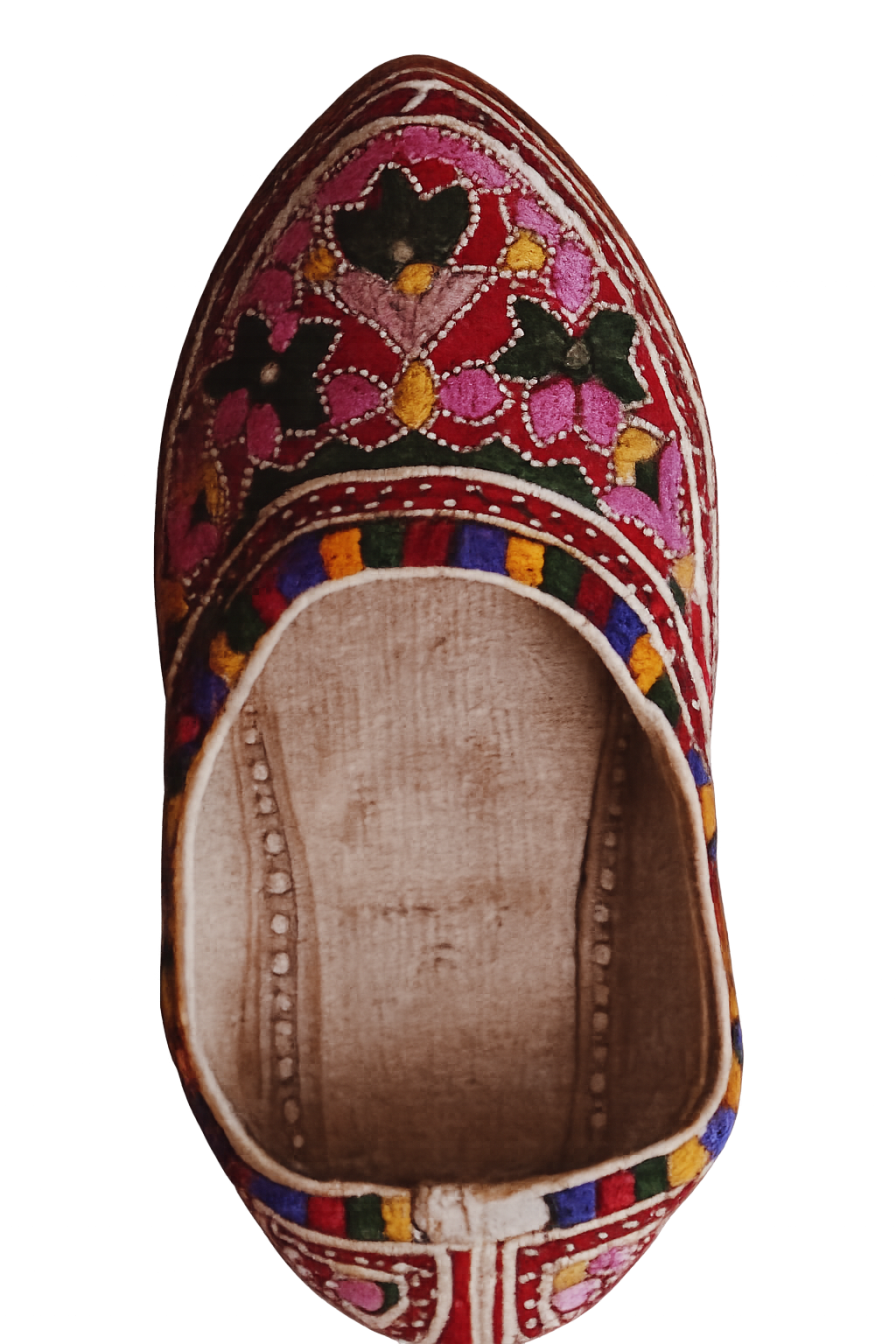
The Kolhapuri chappal is made by the Chambar community, who have worked with leather in this region for centuries. The sole is vegetable-tanned local leather; the upper is cut in curvilinear patterns, punched with geometric designs, and threaded by hand. The distinctive toe ring is functional — it keeps the sandal on the foot without a back strap.

The sandal is designed to be worn loose. A new pair feels stiff and unfamiliar. After several weeks of regular wear, the leather softens along the foot's pressure points and the sandal begins to follow the wearer's gait. This breaking-in period is not a flaw — it is the product's design principle. A six-month-old Kolhapuri fits like nothing else.

The Kolhapuri improves with use. Every step taken in it is a step taken in the making of it. The foot is the last instrument in the craft process. Without the foot, the sandal is unfinished.
  • Chambar leather work
  • Vegetable-tanned sole
  • Punched upper design
  • Toe ring closure
  • Geometric perforation
Kolhapur: Landscape
Kolhapur — landscapeWikimedia Commons
III

Chapter Three

24-Carat Gold — Beaten, Not Cast

सोने का आभूषण · कोल्हापुरी सज

Kolhapuri gold jewellery is made from 24-carat gold — not cast but beaten. The Sonar goldsmithing community works pure gold sheet into forms using hammers and formers, creating objects of remarkable thinness and warmth. The thushi choker — a flat beaded necklace — and the nath nose ring are the signature forms.

The nath is an elaborate circular nose ring worn by Maharashtrian women at weddings, often so large it requires a thread attached to the hair to support its weight. The goldsmith who makes a nath works in 24-carat gold that must be shaped without breaking — a material constraint that demands complete mastery of annealing and forming.

24-carat gold is too soft to be worn hard. It dents. It scratches. It carries the memory of every contact. This is not a defect — it is the gold telling you it is real. The Kolhapuri goldsmith makes things that mark time on their surface. The scratches are the biography of the object.
  • 24-carat beaten gold
  • Nath nose ring
  • Thushi choker
  • Sonar goldsmithing
  • Maratha wedding jewellery
Kolhapur: The craft
Kolhapur — the craftWikimedia Commons
Kolhapur: Detail
Kolhapur — detailWikimedia Commons

यत्र सोना बोलता है, तत्र चमड़ा सुनता है

where gold speaks, leather listens.