Back
19.75° N  ·  75.71° E  ·  Deccan Plateau

State Archive

Maharashtra

महाराष्ट्र · महान देश का हस्तशिल्प

Paithani silk, Warli wall art, Kolhapuri leather, Bidri metal, and the cave paintings of Ajanta — Maharashtra holds India's most layered craft archive.

Deccan Plateau  ·  Sahyadri Range  ·  Konkan Coast

Maharashtra is India's third-largest state and its most industrially complex. But behind the commerce of Mumbai, the historic fortresses of the Deccan, and the pilgrimage routes of the Sahyadris, a deep weave of handcraft traditions continues — carried by Warli painters in the coastal forests, Paithani weavers in Yeola, Kolhapuri cobblers, and the silversmiths of Paithan.

I

Chapter One

Coastal Maharashtra — Mumbai & the Konkan

कोंकण तट · सागर का शिल्प

The Konkan coast — the narrow strip between the Sahyadri range and the Arabian Sea — is one of the most geographically compressed cultural zones in India. Lush, rainy, defined by fishing villages and laterite cliffs. Mumbai sits at its northern end but the Konkan craft tradition belongs to the villages south of the city: Malvan, Ratnagiri, Sindhudurg.

Coconut shell craft and bamboo basketry are primary material arts of the coast. Fishing net knots are functional craft at the marine edge. But the most significant coastal textile tradition is Paithani — though its weaving centre has moved inland over centuries, its material origins connect to the silk trade that ran along the Konkan ports.

Mumbai is the largest city in India. But the craft memory of Maharashtra lives not in the city — it lives in the fishing villages, the riverbank towns, and the forest edge, where the Sahyadri meets the plateau.

Koli fishing community craft — boat-making, net-weaving, terracotta ritual figures — is the original material culture of the Mumbai coastline, now mostly submerged under concrete but still practised in Versova, Madh, and Nariman Point's margin.

720 km
Konkan coastline length
Koli
Original coastal community
3000+
Years of port trade history
  • Bamboo basketry
  • Coconut shell craft
  • Fishing net weaving
  • Koli terracotta
  • Boat carpentry
  • Konkan wood carving
II

Chapter Two

Deccan Sacred Belt — Pune, Nashik & Paithan

दक्खन · पैठणी का देश

The Deccan plateau around Pune and Nashik is Maharashtra's intellectual and spiritual centre. Pune was the capital of the Maratha Confederacy; Nashik sits on the Godavari, one of India's sacred rivers, hosting the Kumbh Mela every twelve years. Paithan — ancient Pratishthana — was one of the great cities of the Satavahana empire and gave its name to Maharashtra's most celebrated textile.

Paithani is a silk saree woven in zari (gold/silver thread) using an interlocking weft tapestry technique. Each Paithani has a distinctive pallu (end panel) with a peacock motif, lotus designs, or paisley patterns worked in pure silk. The saree border and body are woven in complementary colours that shift in different light — a quality called changeable colour, achieved through contrasting warp and weft hues.

A Paithani saree is not worn. It is carried. Families keep them wrapped in cloth for generations — an heirloom object that holds the smell of silk and gold from a loom that no longer exists in the same town.

Nashik is a centre for the grape-growing Sahyadri agricultural tradition but also for bell metal casting (for temple bells and ritual vessels) and the production of copper puja items — lamps, yantras, idols — that supply temple gift shops across western India.

Yeola — Paithani capital

The silk that catches light

Yeola, a small town near Nashik, is today the primary production centre of Paithani. The town's weaving clusters still use handlooms. Authentic Paithani requires pure mulberry silk and 22-carat gold-coated silver zari. The weaving of a single saree takes between two weeks and six months depending on the complexity of the peacock pallu.

  • Paithani silk saree
  • Zari weaving
  • Bell metal casting
  • Copper puja ware
  • Nashik silver work
  • Mahar community cotton
III

Chapter Three

Cave & Textile Belt — Aurangabad, Ajanta & Ellora

अजन्ता · गुफाओं में बुनी गाथा

Aurangabad is the gateway to Ajanta and Ellora — two of the world's great archaeological and artistic sites. Ajanta's cave paintings, executed between the 2nd century BCE and 6th century CE, show the finest Buddhist narrative painting that has survived anywhere in the world. Ellora's cave temples — Buddhist, Hindu, and Jain, cut between the 5th and 11th centuries — represent stone carving at its most ambitious scale.

The city itself is a craft centre. Himroo fabric — a cotton-silk weave with a raised pattern — was developed in Aurangabad as an affordable alternative to the Persian brocades brought by the Mughals. Paithani was also woven here before the industry moved to Yeola. Bidri metalwork — zinc alloy inlaid with silver — came to Aurangabad from Bidar in the Deccan sultanate period.

The painters at Ajanta worked on rock faces sealed for centuries. What they made was not meant to be seen. And yet it survived — in the dark, in the dust — the most complete picture of craft, cloth, and daily life from ancient India that we have.

The Ajanta murals are themselves a textile archive. They show the patterns, the drape, and the colours of fabrics that no longer exist as physical objects — the only record we have of how India's ancient weavers designed cloth.

  • Himroo weaving
  • Bidri metalwork
  • Aurangabad silk
  • Ajanta fresco painting
  • Ellora stone carving
  • Paithani historic centre
IV

Chapter Four

Southern Royal Craft — Kolhapur

कोल्हापुर · चप्पल और चांदी का नगर

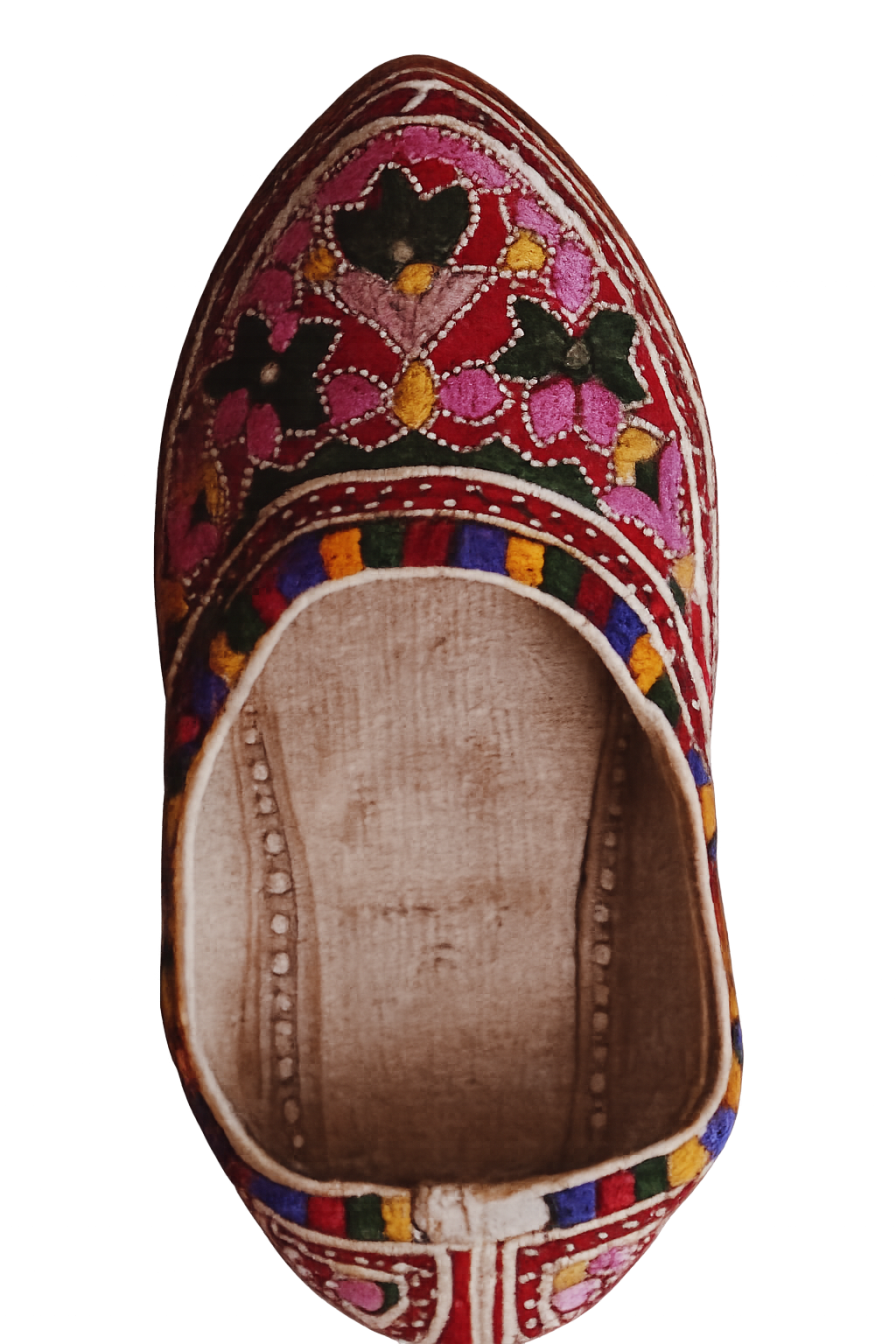
Kolhapur, in southern Maharashtra near the Goa border, was a Maratha princely state whose rulers patronised distinctive crafts. The city is now most famous for two things: Kolhapuri chappal — the flat leather sandal with a distinctive toe ring — and Kolhapur jewellery — 24-carat gold ornaments in the nath (nose ring) and thushi (choker necklace) styles worn by Maharashtrian women.

Kolhapuri chappal is made by the Chambar community, who have been shaping leather in this region for centuries. The sole is tan leather; the upper is cut with characteristic curvilinear patterns, punched, and threaded. The sandal is designed to be worn loose and to develop around the foot with use — a quality that makes new Kolhapuris feel uncomfortable and six-month-old ones irreplaceable.

The Kolhapuri sandal improves with age. It softens in the right places. It takes the shape of your foot. This is not a defect of the design — it is the design. Craft that gets better the longer it is used is craft that was made to be kept.

Kolhapur's 24-carat jewellery tradition — beaten gold, not cast — uses traditional forms: the nath (elaborate nose ring worn at weddings), the thushi (round bead choker), the bangles, and the ear ornaments. These forms have been reproduced outside Kolhapur for decades, but the originals are still made here by the Sonar community goldsmiths.

  • Kolhapuri chappal
  • 24-carat gold thushi
  • Nath nose ring
  • Chambar leather work
  • Sonar goldsmithing
  • Kolhapuri jaggery
V

Chapter Five

Warli Forest Belt — Palghar & the Sahyadri Edge

वारली · रेखाओं में जीवन

The Warli tribe lives in the forests of Palghar district, on the northern edge of Mumbai's hinterland — a world of teak and sal trees, seasonal rivers, and village clusters that maintain an art tradition that is both ancient and immediately recognisable. Warli painting uses a single visual vocabulary: white pigment on mud or cloth, geometric figures — triangles (bodies), circles (heads), lines (limbs) — arranged into scenes of daily and ritual life.

Traditionally, Warli paintings were made by women on the interior walls of homes for festivals and ceremonies — particularly the marriage ceremony, for which the chowk (central square painting) with the goddess Palaghata is essential. The figures in Warli painting do not face the viewer. They are always in motion — dancing, fishing, farming, hunting, climbing trees — a visual field of continuous activity.

Warli art was not made to be looked at. It was made to be inside. The wall it was painted on was the wall of a marriage room — and the goddess at the centre was the room's actual purpose. The painting was the ritual. The canvas was the home.

In the 1970s, Jivya Soma Mashe — a Warli artist from Thane district — began making Warli paintings on paper and cloth for wider audiences. His work, and that of his son Balu Mashe, brought global recognition to a tradition that had previously been entirely community-bound and ephemeral. The Warli image is now one of India's most recognised folk art forms — on textiles, ceramics, walls, and screens worldwide.

  • White rice paste pigment
  • Triangle-circle geometry
  • Chowk marriage painting
  • Palaghata goddess
  • Bamboo motifs
  • Tarpa dance scene
VI

Chapter Six

The Living Thread — Maharashtra's Craft Continuity

जीवित धागा · परंपरा का नाद

Maharashtra is a state that industrialised early and intensely — Mumbai was India's first major industrial city, and the Deccan mills followed. But Maharashtra's handcraft traditions did not disappear. They adapted, found new forms, new markets, and new practitioners who understood the value of what their grandparents had made and chose to continue making it.

The Chitrakathi narrative painting tradition of Pinguli village — practised by the Thakar tribe — uses bold black outlines on paper to tell stories from the Ramayana and Mahabharata. Solapuri cotton chaddar (bedspread) remains a defining domestic textile — simple, durable, instantly recognisable by its checked pattern. Sangli turmeric and Nagpur orange are agricultural craft traditions — the material intelligence of growing and processing embedded in place.

Maharashtra's craft traditions survive because they remain useful. The Kolhapuri sandal is worn every day. The Warli mural is painted for a marriage that actually happens. The Paithani saree is carried to a daughter's wedding. Usefulness is the deepest form of preservation.

From the Warli forests of the north to the Kolhapuri leather workshops of the south, Maharashtra's craft archive is a map of the state's ecological zones, its community identities, and its historical memory. Each tradition is a coordinate: it tells you where you are, who made it, and why it was worth keeping.

  • Chitrakathi painting
  • Solapuri chaddar
  • Sangli turmeric
  • Dhurrie rug weaving
  • Nagpur cotton
  • Tribal bamboo craft

यत्र शिल्पः जीवनं अस्ति, तत्र संस्कृतिः नश्यति न

where craft is life, culture does not perish.