Back
22.97° N  ·  78.65° E  ·  Heart of India

State Archive

Madhya Pradesh

मध्य प्रदेश · भारत का हृदय

Gond painting, Maheshwari silk, Chanderi weave, Dhokra metal casting, Khajuraho stone — the heart of India carries its craft like heartwood, from the inside out.

Narmada Valley  ·  Vindhya Range  ·  Satpura Forest

Madhya Pradesh is the geographic centre of India — and its cultural depth reflects that position. It holds more Gond tribal artists than anywhere else, the finest handloom silk on the Narmada, temple sculpture that shaped the subcontinent's visual vocabulary, and a music lineage that runs from Gwalior's court to every classical gharana that followed.

I

Chapter One

Lake & Heritage — Bhopal

भोपाल · झीलों का शहर

Bhopal is a city that opens onto water. The Upper and Lower lakes sit at its heart, and the old city — the Nawabi Bhopal that developed under the rule of the Begums of Bhopal — is dense with architectural heritage, bazaars, and craft traditions that emerged from a Muslim royal court in the middle of central India.

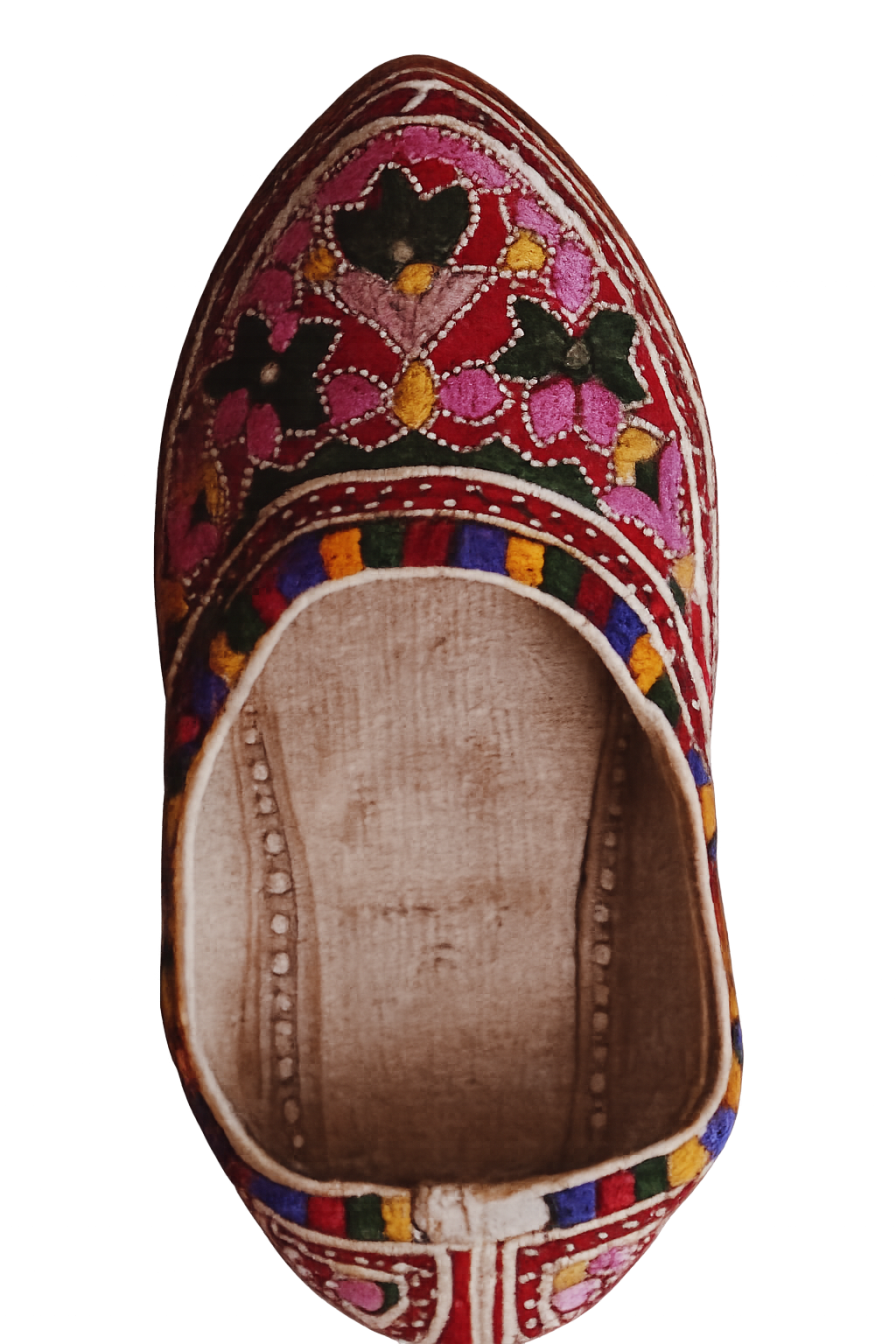
Zardozi embroidery — gold thread work on velvet and silk — was a court art developed under Nawabi patronage. Bhopal zardozi uses metal wires coiled and stitched into relief patterns of flowers, birds, and arabesque geometry. It appears on bags, footwear, garments, and cushion covers — the ornamental surface language of the old city's textile identity.

Bhopal's craft memory is a Nawabi memory — gold thread on velvet, chikan on fine muslin, the embroidered bolster on a low divan in a marble room. It is opulence expressed in stitch, and stitch expressed in the hands of families who kept the knowledge while everything else changed.

Bhopal is also the seat of Madhya Pradesh tribal museum culture — the Rashtriya Manav Sangrahalaya (National Museum of Mankind) holds the most significant collection of Indian tribal architecture and material culture in the country. It is the intellectual centre of the Gond, Bhil, Korku, and Baiga tribal traditions of the state.

11th c.
Founding of original city
4
Begums of Bhopal who ruled
RMS
Largest tribal museum in India
  • Zardozi embroidery
  • Bhopal jari work
  • Chikan embroidery
  • Nawabi textile heritage
  • Silver filigree
  • Batik printing
II

Chapter Two

Malwa Sacred-Urban — Indore & Ujjain

मालवा · उज्जयिनी का प्रकाश

The Malwa plateau around Indore and Ujjain is one of the most densely religious landscapes in India. Ujjain — one of the seven sacred Hindu cities — sits on the Shipra river and hosts the Kumbh Mela every twelve years. The Mahakaleshwar Jyotirlinga here is one of the twelve most sacred Shiva shrines in India. This density of pilgrimage has sustained a continuous market for craft objects: brass and copper ritual ware, devotional images, incense, and cloth offerings.

Chanderi — the fabric — comes from a small town 230 kilometres southeast of Indore. Chanderi sarees are woven in silk-cotton blends, known for their extreme lightness, translucency, and the characteristic diagonal weave texture called woven air. The pallu features traditional motifs — the dandidar (stick) stripe, the coins (sikka), the flowers — worked into the border with a supplementary weft.

Chanderi cloth is said to be woven from air and water. This is not hyperbole. It is a description of texture — the fabric that floats when you hold it up to light and disappears when you lay it flat against the skin.

Indore itself is a craft bazaar city — home to large markets in brass, pottery, lacquerware, and the hand-block-printed textiles of Malwa. The Dhar and Mandu districts nearby carry the architectural legacy of the Malwa Sultanate, and the stone-carving and woodwork traditions that served those royal buildings still exist in local workshops.

  • Chanderi saree
  • Woven silk-cotton
  • Ujjain brass ware
  • Block-printed cotton
  • Lacquerware
  • Malwa pottery
III

Chapter Three

Fort & Music — Gwalior

ग्वालियर · संगीत का किला

Gwalior Fort stands on a flat-topped hill 100 metres above the city — a sandstone mass that has been held by the Huns, the Gurjara-Pratiharas, the Tomars, the Mughals, and the Marathas in succession. Each left something in the stone. The fort is an architectural palimpsest, and the city below it is a music palimpsest — the origin point of the Gwalior Gharana, India's oldest Khyal singing tradition.

Tansen — court musician of Akbar and India's most legendary singer — is buried in Gwalior. The Tansen Sangeet Samaroh, the largest classical music festival in India, is held here annually at his tomb. This tradition of musical patronage created a parallel craft tradition: instrument-making. Gwalior has been a centre for tabla-making, sitar and tanpura construction, and the crafting of traditional wind instruments.

Gwalior's fort was built to be taken and retaken. Its music was built to last. The fort is stone, and stone can be occupied. The raga is sound, and sound carries in the air from whoever sang it to whoever listens now, with no walls between them.

Gwalior pottery

The blue-painted tradition

Gwalior has a minor but distinct pottery tradition — terracotta painted with cobalt blue and white floral patterns, influenced by the Mughal blue-and-white ceramic aesthetic. The ware is mainly decorative: small boxes, vases, and tiles used in architectural contexts.

  • Tabla-making
  • Sitar construction
  • Gwalior blue pottery
  • Fort stone carving
  • Tansen tomb complex
  • Leather drumheads
IV

Chapter Four

Temple Sculpture — Khajuraho

खजुराहो · पत्थर में बना जीवन

The temples at Khajuraho — built by the Chandela dynasty between 950 and 1050 CE — are among the most extraordinary objects India has produced. They are not buildings with sculptures on them. They are sculptures that happen to function as buildings. Every exterior surface of the main temples is covered in a continuous band of carved stone figures: musicians, dancers, celestial beings, attendants, and the erotic scenes that made Khajuraho famous.

But the erotic carvings are not the point of Khajuraho. They occupy perhaps 10–15% of the sculptural programme. The rest is a complete visual index of 10th-century life: the way clothes draped, the jewellery women wore, the musical instruments that were played, the animals that were revered, the gestures of daily devotion. Khajuraho is the best-preserved material record of the Chandela world.

Khajuraho's sculptors left the most detailed record of 10th-century Indian dress, jewellery, and adornment that we have anywhere. The figures are not abstractions. They are portraits of what people wore and how they wore it carved in sandstone that has not forgotten a single fold.

Contemporary stone carving around Khajuraho continues, primarily producing replicas and devotional images using the same Vindhyan sandstone that the original temples used. The local craft tradition in stone is a direct descendant of the Chandela temple workshop — the only difference is the scale.

  • Vindhyan sandstone carving
  • Chandela temple sculpture
  • Contemporary replica craft
  • Devotional image-making
  • Architectural relief carving
  • UNESCO World Heritage site
V

Chapter Five

Narmada Handloom — Maheshwar

महेश्वर · नर्मदा की बुनावट

Maheshwar sits on the north bank of the Narmada river, 91 kilometres from Indore. It was the capital of the Holkar Maratha empire under Ahilyabai Holkar — an 18th-century queen revered across India for her rule, her temple-building, and her patronage of craft. The Maheshwari saree was woven here under her direct patronage, and the tradition she established continues today.

Maheshwari is a silk-cotton saree woven in warm, earthen shades: dusty rose, saffron, mustard, rust, and deep green. The characteristic features are the reversible border — the same on both sides — and the pallu with five stripes of contrasting colour. The weave uses a traditional pit loom and the supplementary weft for the border is worked without a template, from the weaver's memory.

Ahilyabai Holkar brought weavers to Maheshwar from across India. She gave them land, looms, and a river. Two and a half centuries later, the looms are still there, the river is still there, and the saree still carries her name without saying it — in every border that is the same on both sides.

The Rehwa Society, founded in 1979 to revive Maheshwari weaving after its decline, is a major living example of craft revival in India. It employs hundreds of weavers in Maheshwar and has turned the tradition into a globally distributed product while keeping the production entirely local and handmade.

The Narmada's other craft

Narmadeshwar Shivlings — stone from the riverbed

Narmadeshwar Shivlings — naturally formed cylindrical stones from the Narmada riverbed at Omkareshwar — are collected, polished, and sold as sacred objects throughout India. The stone formation is natural; the selection, polishing, and distribution is a long-established craft tradition and religious economy.

  • Maheshwari saree
  • Reversible border weave
  • Rehwa Society
  • Narmadeshwar Shivling
  • Omkareshwar pilgrimage craft
  • Silk-cotton handloom
VI

Chapter Six

Gond Forest — Mandla & the Satpura

गोंड · जंगल की भाषा

The Gond people are the largest tribal community in India, with the majority living in the forests of Madhya Pradesh — primarily in Mandla, Dindori, Balaghat, Seoni, and Chhindwara districts, in and around the Satpura and Maikal ranges. Their art tradition is one of India's most significant — not a folk tradition for tourists, but a complete visual language that carries the Gond understanding of the natural world.

Gond painting uses densely layered dots and lines to fill forms — animals, trees, birds, deities — with texture that vibrates. The tiger, the peacock, the fish, and the tree of life are primary subjects. Backgrounds are filled; there is no empty space. The paintings are not illustrative — they are equivalent to prayers: making the natural world visible is an act of devotion.

Jangarh Singh Shyam — the Gond artist who first painted on paper — was brought to Bhopal's museum in 1981 and asked to paint the walls. He painted what he knew: the forest, the animals, the spirits. The walls of Bhopal became a Gond forest. He had not changed what he was making. He had only changed the surface.

The Baiga and Bhil tribal communities of MP carry their own art traditions alongside the Gond. Baiga body tattooing and textile design; Bhil painted pithoras (large ceremonial wall paintings involving horses, deities, and processions) — each tradition is a distinct visual language from the central Indian forest.

Dhokra — lost-wax brass casting — is a Bastar craft that extends into southern MP. Tribal sculptors cast animals, human figures, and deity forms using beeswax models coated in clay, then melted out and replaced with molten brass. The surface of Dhokra pieces carries the texture of wax — organic, slightly rough, warm in the hand.

13M+
Gond population in MP
1981
Year Jangarh Singh Shyam began painting
4000+
Years of Dhokra craft history
  • Gond painting
  • Jangarh Kalam
  • Dhokra brass casting
  • Bhil pithora mural
  • Baiga tattooing
  • Tribal bamboo & wood

यत्र वनं शिल्पं वदति, तत्र मनुष्यः सुनता है

where the forest speaks through craft, humanity listens.