Case study · 03
Food Origin.
Search a dish and walk backwards through it. Seventeen exhibits, a hundred and thirty-three dated versions, and every single one of them labelled with how sure the research actually is.
What it is
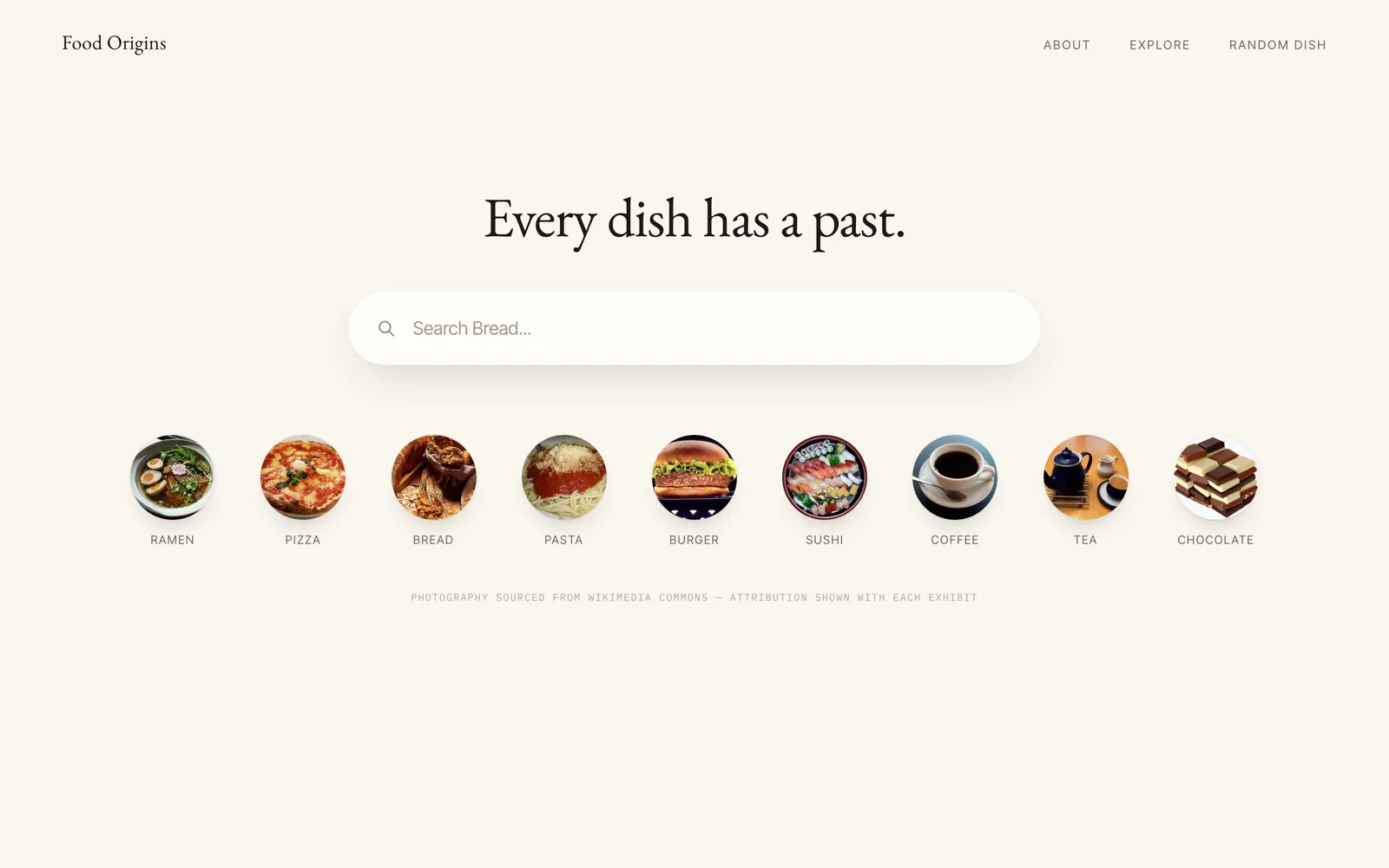
Every dish has a past.
Search a dish. What comes back is not an article about it — it is an exhibit: a timeline of that food’s own versions, newest first, each one a different thing with a different name, a different place, and its own working recipe.
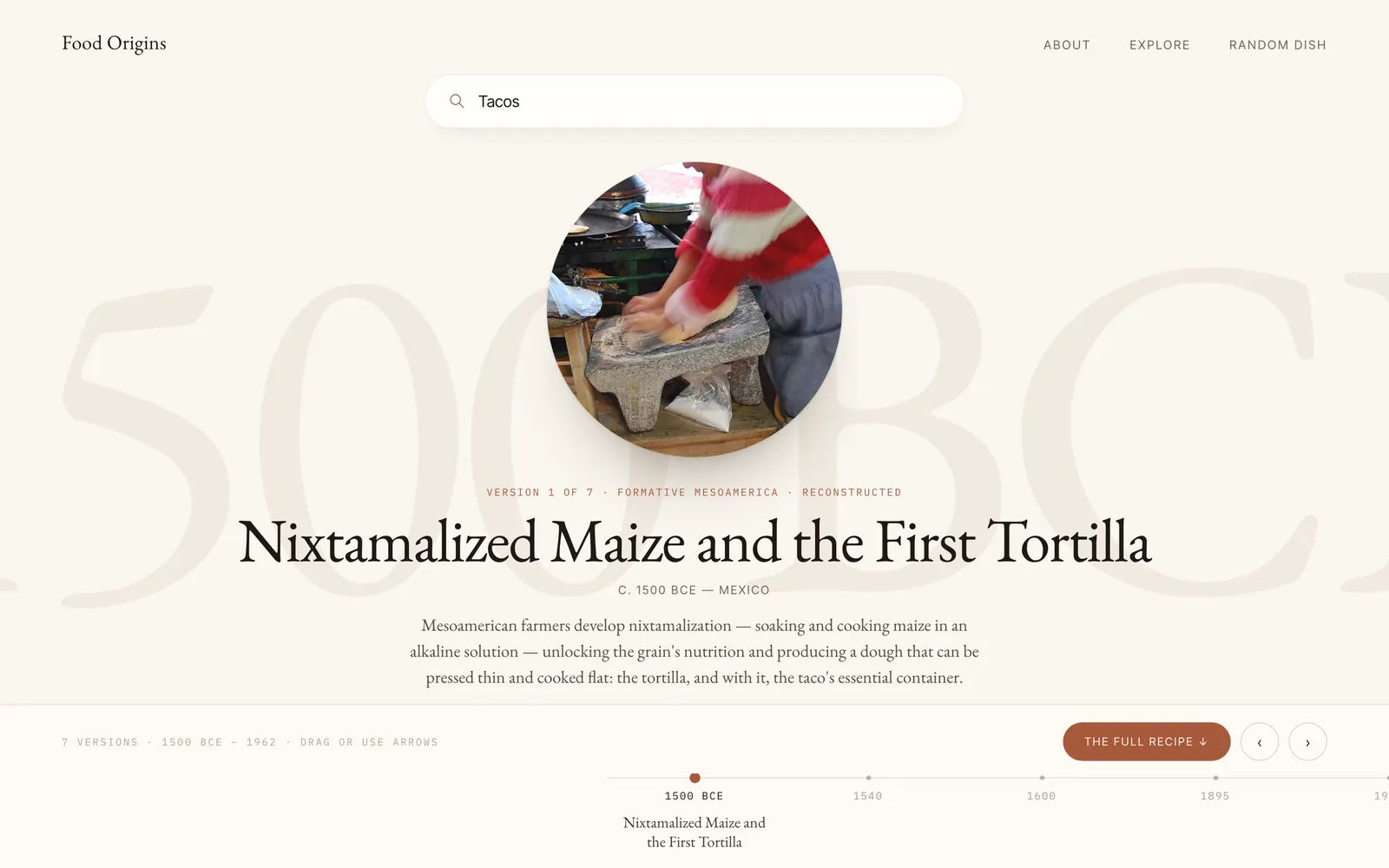
Pizza is eight versions from a dressed flatbread in 600 BCE to the European Union fixing Neapolitan pizza in law in 2009. Bread is eight, starting at roughly 12,400 BCE. Biryani is seven, from a Persian pulao to the most-ordered dish in India. You do not read down a page; you move along a rail, and the whole stage crossfades under you.
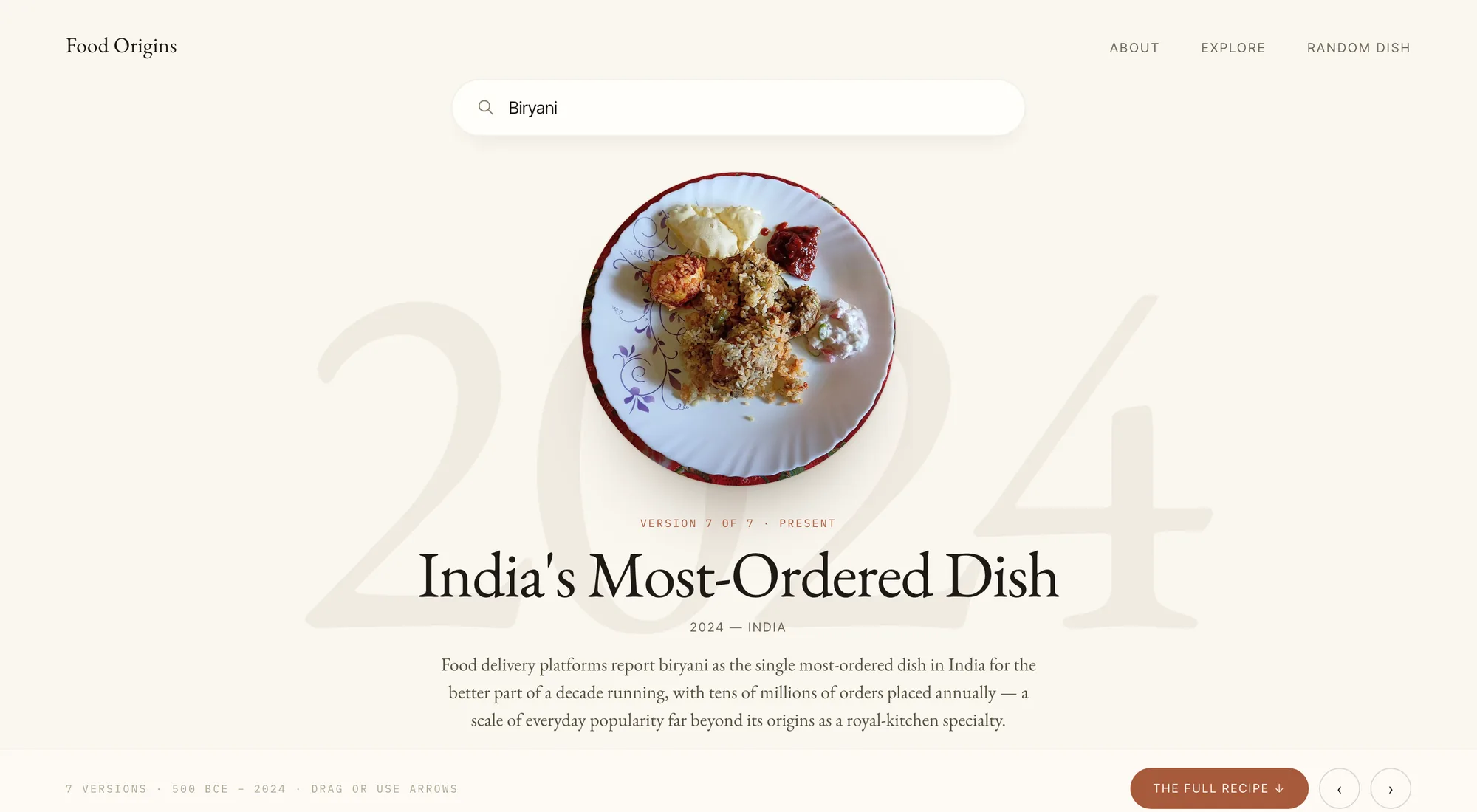
Researched, written and sourced in full.
Six to twelve per dish, each its own era.
Documented, well supported, reconstructed, uncertain.
Photograph, artefact, illustration or recreation — declared.
Counted from the source, not estimated — 121 authored nodes across 16 dish files, plus the 12-node seeded Ramen exhibit.
The problem.
Food history is one of the most written-about subjects there is, and almost all of it arrives in the same two shapes: a listicle (“ten foods you won’t believe are ancient”) or an academic paper. The first is confident and unsourced. The second is sourced and unreadable.
Between them sits the thing a curious person actually wants, which is neither a fact nor a bibliography: a sense of change. Not “pizza is from Naples” but the eight distinct objects that have carried that name, in order, and what made each one turn into the next.
The other half of the problem is the one every food-history claim has: the record is uneven. Some of it is legislated fact and some of it is a reasonable guess about the Neolithic. A product that flattens those into the same voice is lying, and a product that footnotes every sentence is unreadable. That tension is what §04 is about.
A museum, not a feed
The vocabulary of the whole product is a museum’s. Dishes are exhibits. Eras are versions. A dish that has not been researched yet is a gallery that is closed. That is not decoration — it sets the expectation that what you are looking at was assembled by someone, deliberately, and that some rooms are not open.
Three decisions that follow from it
Backwards, not forwards. The timeline opens on the present and walks into the past. You start with the thing you have eaten, which is the only version you have any purchase on, and each step back takes something away.
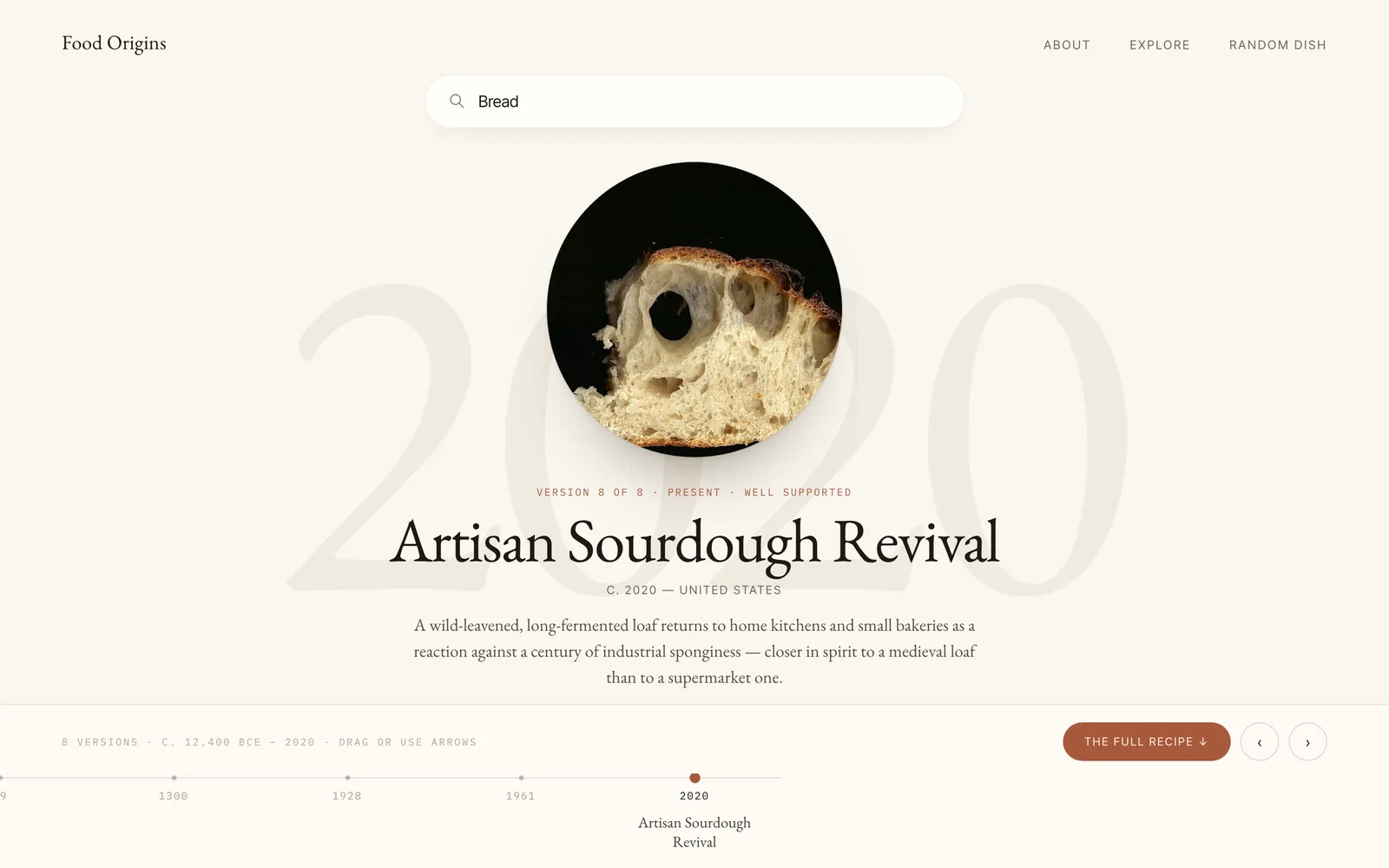
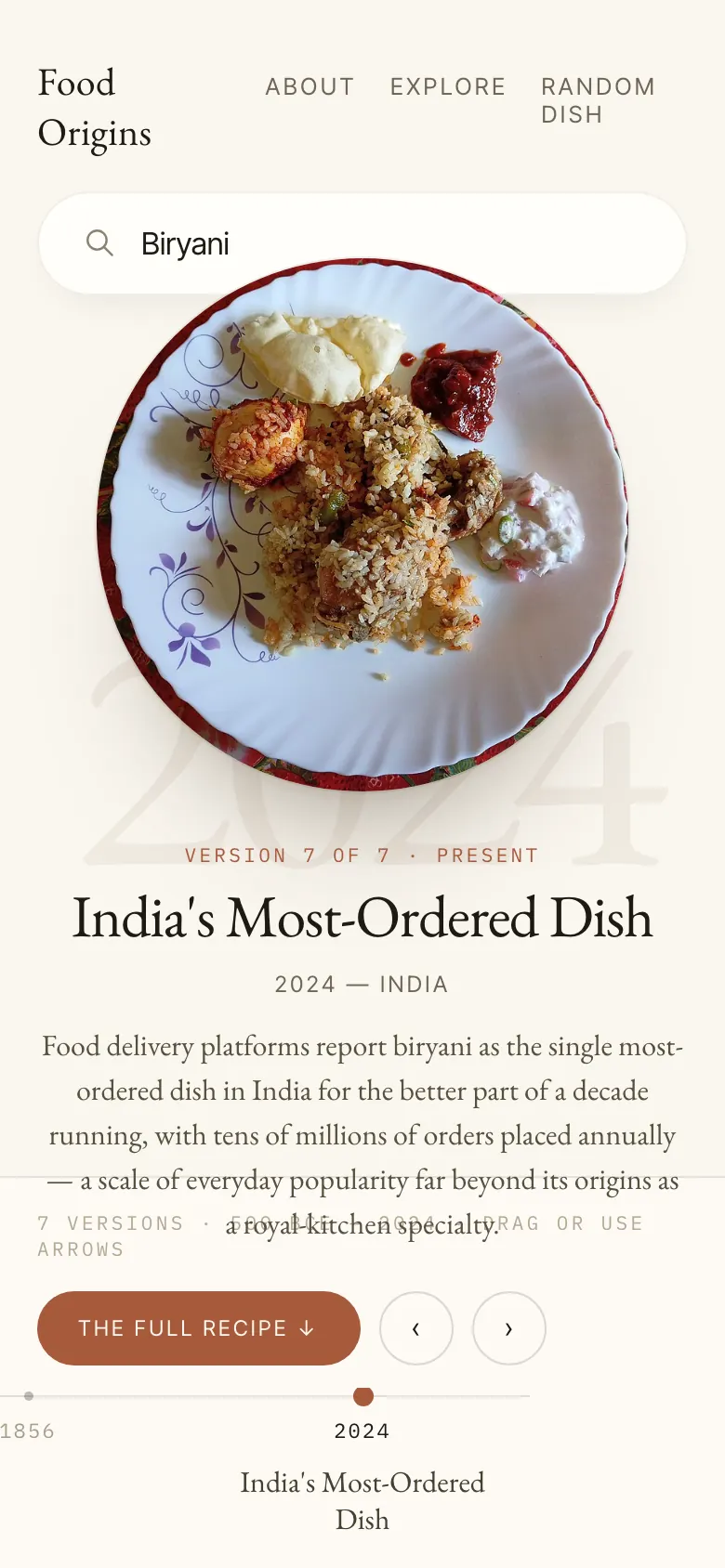
One version fills the screen. There is no scrolling list of eras. The stage holds exactly one — portrait, era label, title, place, summary, and the year set enormous and pale behind all of it. Changing era crossfades the image, the text, the recipe and the rail indicator in place; nothing reloads and nothing navigates.
The rail is the map. The bottom of the screen carries every version at once, dated, so the shape of the dish’s history is visible even while you are inside one moment of it. Drag it, or use the arrow keys.
How sure is this, exactly?
Every version carries its own confidence rating.
The data model has four tiers — documented, well-supported, reconstructed, uncertain — and every one of the 133 versions has one. Across the library they land like this:
- 45 documented. There is a record. The 2009 EU regulation fixing Pizza Napoletana is one of these.
- 40 well supported. Not legislated, but not in dispute either.
- 21 reconstructed. Built from period sources rather than from a surviving recipe.
- 15 uncertain. Said out loud rather than smoothed over.
Where the label goes
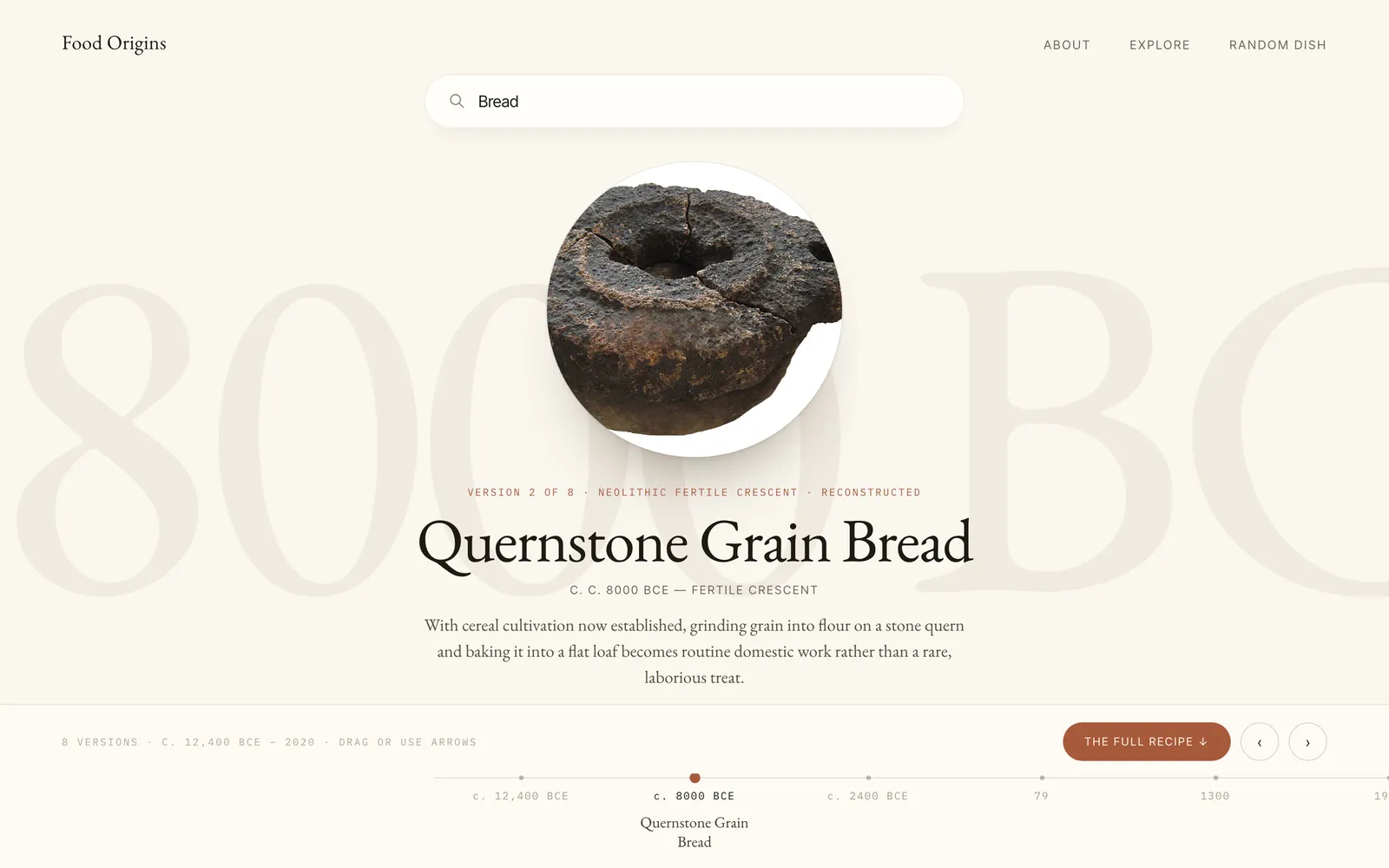
On the era line, in the same breath as the period. Not a footnote, not a tooltip, not an info page:
VERSION 2 OF 8 · NEOLITHIC FERTILE CRESCENT · RECONSTRUCTED
And — the detail that makes it work — documented prints nothing at all. A label on every version would become wallpaper within two clicks. Printing it only when the answer is anything less than documented means the label is always news. The component’s own comment says why: “Historical honesty belongs on the label, not in a footnote — and folding it in here keeps the stage exactly as tall as designed.”
The same discipline on the images
Historical periods do not have photographs. So every image declares what it actually is — photograph, artefact, illustration, recreation or placeholder — alongside its credit and licence. A modern recreation of a Neolithic loaf is never allowed to sit on the page pretending to be evidence.
Every version is cookable
Under each exhibit there is a full recipe, and it is the part that turns the timeline from a reading experience into something you can act on. It carries more than ingredients and steps:
- A modern stand-in per ingredient, where the historical one is unavailable or impractical — Mozzarella di Bufala Campana DOP, 250 g followed by TODAY · FIOR DI LATTE, DRAINED OVERNIGHT.
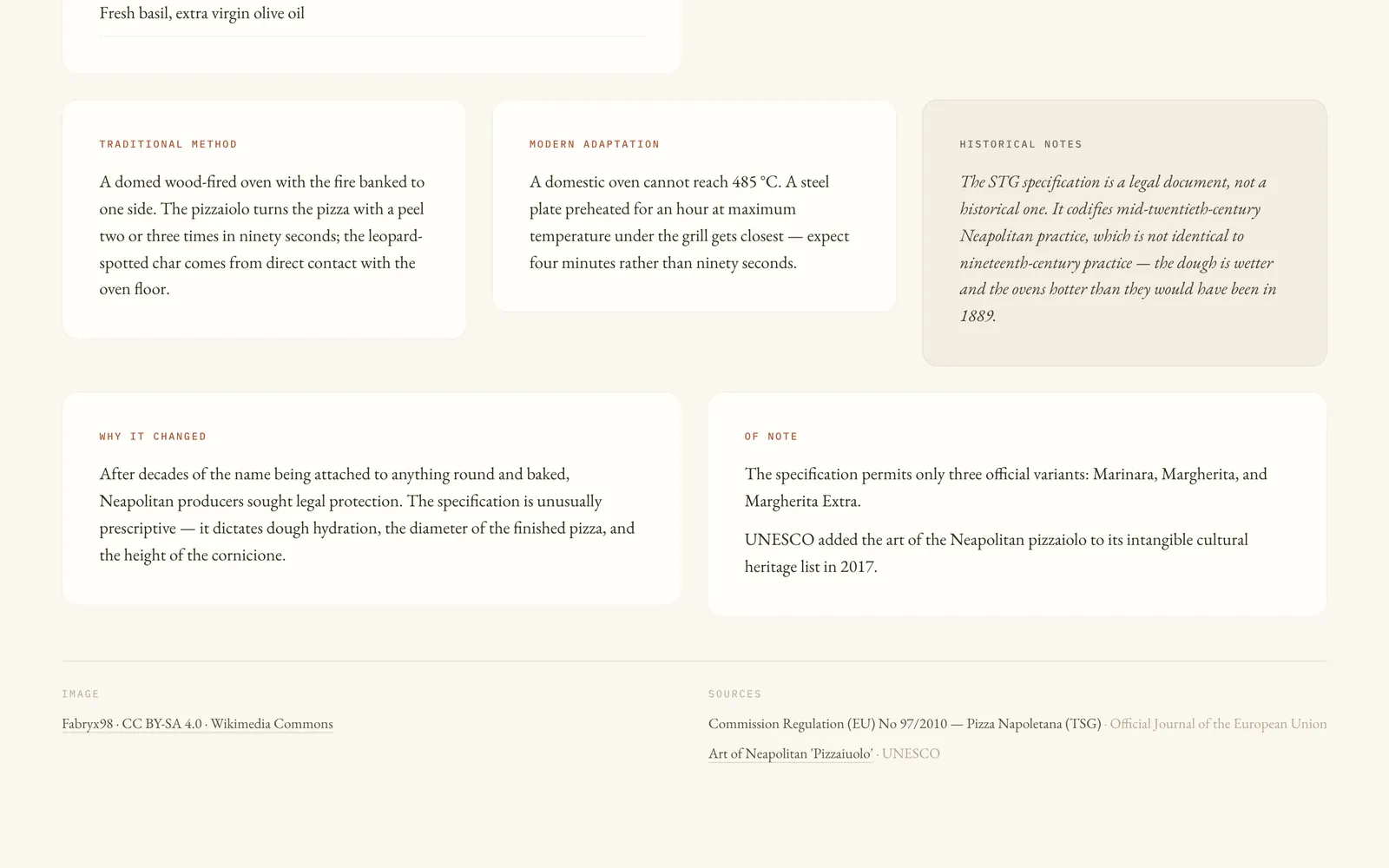
- Traditional method and modern adaptation, separately. The traditional entry for Pizza Napoletana describes a domed wood-fired oven and a pizzaiolo turning the pizza two or three times in ninety seconds. The modern one admits that a domestic oven cannot reach 485 °C, and tells you what actually gets closest.
- Historical notes, where the record is contested. Pizza’s says, flatly: “The STG specification is a legal document, not a historical one. It codifies mid-twentieth-century Neapolitan practice, which is not identical to nineteenth-century practice — the dough is wetter and the ovens hotter than they would have been in 1889.”
- Why it changed — the sentence that connects this version to the next one along the rail.
That last pair is the whole product in miniature. The recipe is usable, and the page tells you what is legislation and what is practice, in the same panel, without making you choose.
Two builds, and the difference matters
This is the thing to be exact about, because it is the one claim a project like this can most easily overstate.
-
What is published at /foodorigins
static exportA fixed collection of 17 exhibits. No server, no API route, no key, no research happening anywhere. Every one of the 133 versions was researched, written and sourced before the build, and is bundled as data. Searching for anything outside the 17 cannot produce a new exhibit, and does not pretend to.
-
What exists in development
next dev, with a keyA working research pipeline. Search any dish and it is researched live — web search, a schema-constrained structuring pass, Wikimedia image lookup with real attribution, and the result cached. See §07.
How the deployed build says so
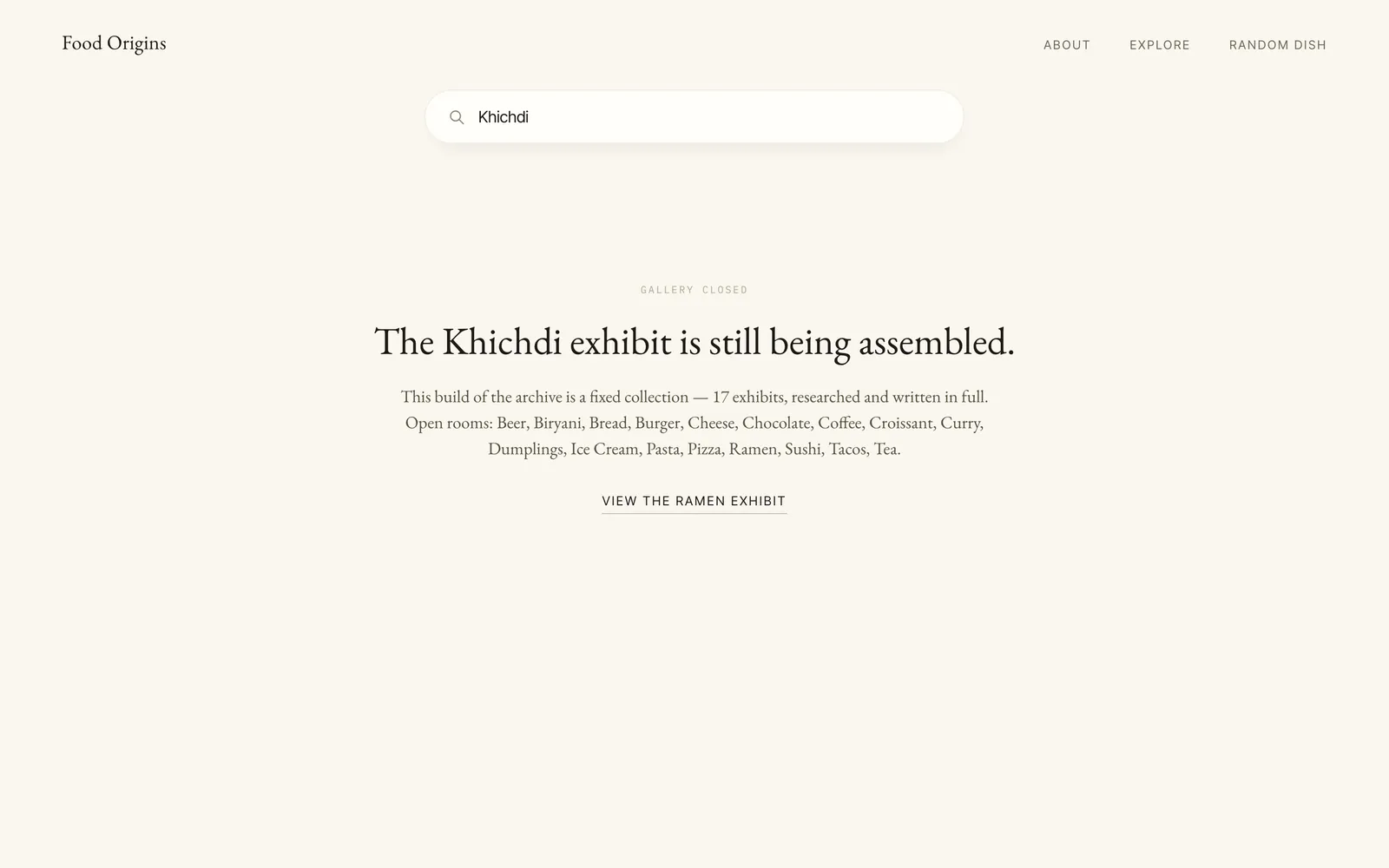
Search for something outside the collection and the empty state does not apologise vaguely or offer to “try again”. It names the situation and then lists every room that is open:
This build of the archive is a fixed collection — 17 exhibits, researched and written in full.Food Origin · the empty state
A static export has no server to hold an API key and no per-visit research cost. The build script moves the API route aside for the duration of the build and puts it straight back — including on failure, via a trap — so the source is never edited to make the deploy work.
The trade is real and it is the right way round: the public gets 17 exhibits that are finished, checked and free to serve, instead of an unlimited search that would sometimes be wrong and always cost money.
The research pipeline
In development, a search runs through six stages:
query → cache → research → structure → images → store → render
The interesting part is that research and structuring are two separate passes. The first has web search and writes a prose brief. The second has no tools at all, so it can only reformat what the first pass already established, and its output is constrained to a JSON schema. A model that cannot reach the internet cannot invent a source during the tidying-up step.
What the prompt forbids
The accuracy rules are written into the prompt as constraints, not suggestions:
- “Never invent an event, a date, a person, or a recipe. If the record is thin, say the record is thin.”
- “Where several theories compete, present the best-supported one and name the others as disputed.”
- “Distinguish clearly between: an attested recipe, a reconstruction from period sources, and an informed guess. Label which you are giving.” — which is exactly where the four confidence tiers come from.
- “Popular etymologies and origin stories are usually tidier than the truth. Flag them when you repeat them.”
- Optional fields with nothing to say take an empty string — never a placeholder like “unknown” or “N/A”.
It also has a refusal path. If the query is not a real food with a traceable history, the first pass replies NOT_A_DISH: <one sentence> and the pipeline stops there rather than producing a confident timeline for something that does not have one.
Images it will not fabricate
Image lookup goes to Wikimedia Commons with real per-image attribution, and falls back in a fixed order: a modern example of the dish, then the design’s own hatched paper texture. It never generates a historical photograph, because there is no such thing as a photograph of Neolithic bread.
It is an authoring tool — a way for one person to research and draft an exhibit far faster than by hand, with the honesty constraints built into the process rather than remembered afterwards.
It is not what serves the public site, and it is not a claim that the output is unsupervised-safe. All 17 published exhibits are written and checked; the pipeline is the reason there are 17 rather than three.
Where it stands
Live at /foodorigins: 17 exhibits, 133 dated versions, a full recipe under each one, sources per version, typed and credited images, and an empty state that tells the truth.
The data model was built for more than currently exists, and says so in its own comments: nodes already carry country and city for a map, ingredients are structured with substitutions for an ingredient-evolution view, sources is already per-node for a source viewer, and nodes can become a tree without touching the rendering contract, for dishes whose history genuinely branches.
Seventeen dishes is a small museum. It covers the obvious global canon — pizza, ramen, sushi, coffee, tea — and the gaps are exactly where a food archive is most worth having. The pipeline exists to close that gap; nothing has closed it yet.
The built-for-next-phase features are not built. The map, the ingredient view, the source viewer and branching timelines are all shapes the model can carry and none of them exists in the interface.
No public research. Turning the pipeline on for visitors would need a server, a key, a cost model and a review step for anything it produces. That is a product decision, not a technical one, and it has not been made.
If the record is thin, say the record is thin.Food Origin · the research prompt
The live archive
Search a dish.
Seventeen rooms are open. Bread goes back to roughly 12,400 BCE, and every version of it comes with a recipe.