Process
The versions that didn’t ship.
Every case study on this site ends with what is still missing. This page is the other half of that: the working files that are still on disk, screenshotted exactly as they are.
Eight homepages
The same site, argued eight ways.
Seven earlier versions of this homepage are still in archive/, each one a complete working page rather than a mockup. They are not deployed — that folder is in .vercelignore — but they open and run exactly as they did when they were the live site.
The filenames carry their own history: simple-hero, dark-hero, light-editorial, fieldwork, ui1-rebuild, polish. Read in order they show a site that started serif and dark, went editorial and white, then found red — and only then started arguing about what the headline should say.
Every image above is a screenshot of a file that is still in this repository, rendered as it is. Nothing here was redrawn for this page.
Two rejected headlines, kept.
v6 says “I build stories.” v7 says “I build interfaces.” Both are true and neither is sufficient, which is the usual problem with a headline that has to cover a field guide, a craft archive and a driving game.
The live site does not choose. Its headline is the same sentence with a word that rotates, and the array behind it is:
['worlds', 'systems', 'stories', 'interfaces']
Two of those four are the rejected headlines. They were not thrown away and they were not merged into something blander — the disagreement between v6 and v7 became the mechanism. Someone reading the page for three seconds gets one answer; someone who stays gets all four.
It is the smallest possible example of the thing this page exists to show. The interesting part of a design decision is rarely the version that shipped — it is what the earlier ones were arguing about, and what happened to the argument.
Design, and what got built
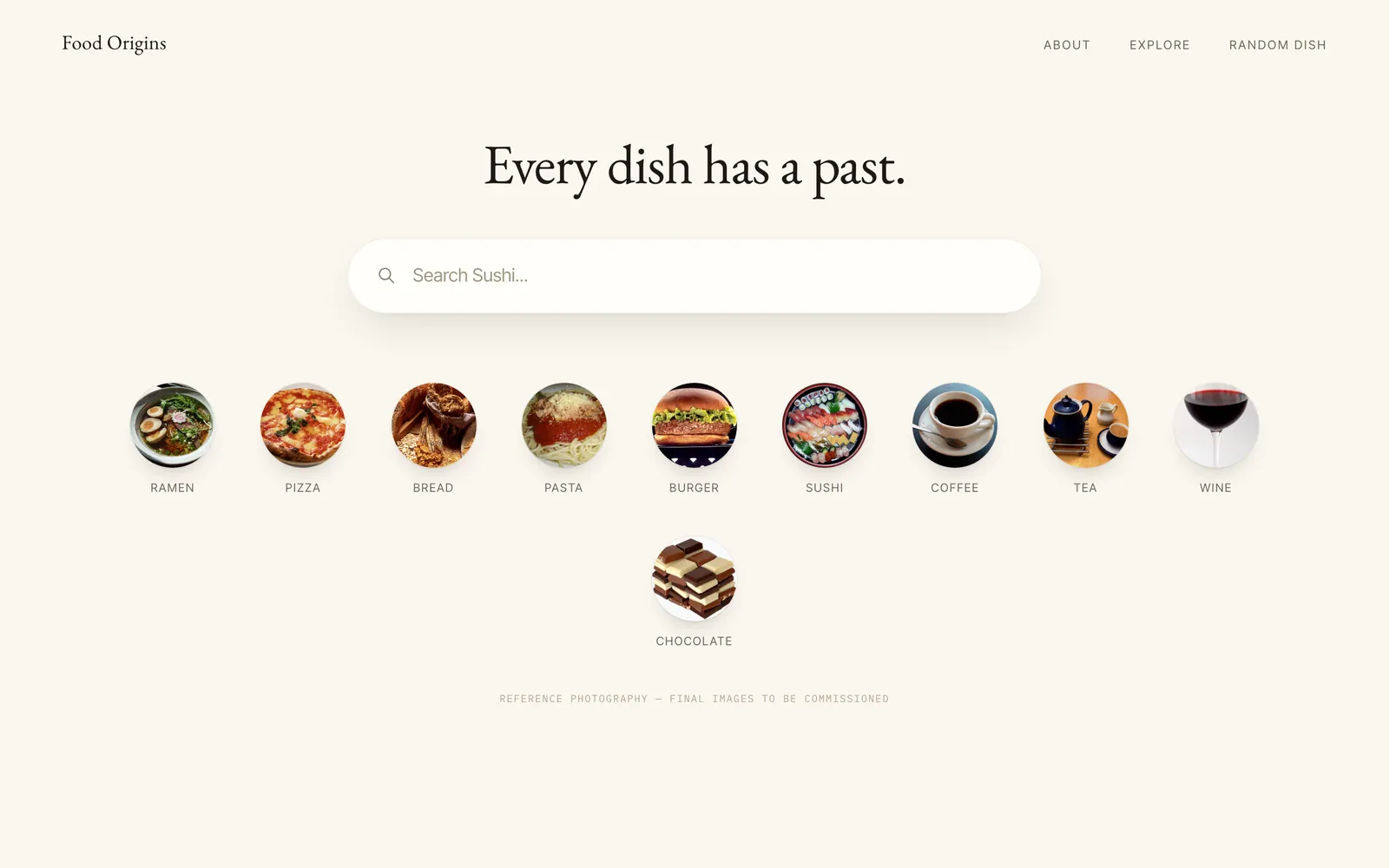
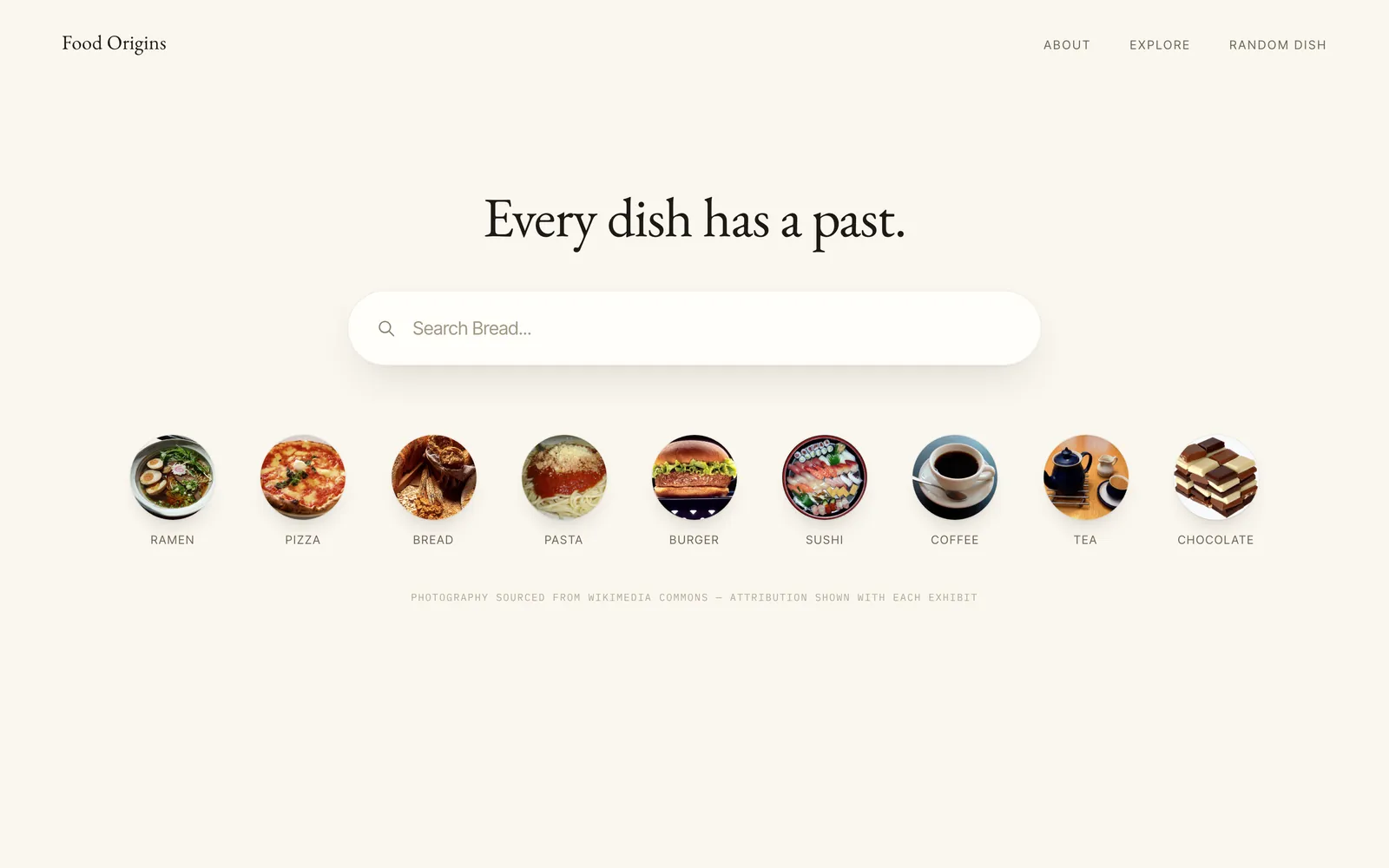
Food Origin was built against a design prototype that is still in the repository as a single self-contained file. Putting it beside the shipped build shows two changes, and both were decisions rather than drift.
-
Wine was cut
The prototype has ten dish chips and the tenth is wine, which wraps the row onto a second line. The build has nine and they fit on one. Wine is also the only one of the ten that is not a dish.
-
The photography plan changed
The prototype’s footer says REFERENCE PHOTOGRAPHY — FINAL IMAGES TO BE COMMISSIONED. The build’s says PHOTOGRAPHY SOURCED FROM WIKIMEDIA COMMONS — ATTRIBUTION SHOWN WITH EACH EXHIBIT. The plan to commission images was dropped, and rather than leave the question open the build committed to sourced, credited, licence-checked images — which is where the whole per-image attribution system in that project comes from.
What isn’t here
A process page is the easiest page on a portfolio to fake. Sketches can be drawn afterwards. Wireframes can be made from the finished screen and presented as the thing that came before it. So this section says what this archive does not contain.
No sketches or wireframes. None exist for any of the three case-study projects. Rather than reconstruct one and let it read as historical, there is nothing.
No dates on v2–v7. Only the notebook carries a recorded date — 2026-07-25, written in its own README. The other six are ordered by the numbers in their own filenames, which is a real ordering and not a timeline.
No before-and-after for Mugger City or Tribal Traces. Both exist only in their finished state. If earlier versions exist outside this repository, they belong here.
The one thing most worth finding: Tribal Traces’ map is built from per-state coordinate arrays extracted from dotted PNGs — the source comments still name gujarat-dots.png. Those source images are the best process artefact this portfolio could have, and they are not in the repository.
The finished versions
What all this turned into.
Three case studies, each ending with what is still unfinished about the project it describes.